
Mow your lawn at 3‑4 inches for cool‑season grasses and 1‑2 inches for most warm‑season varieties, never cutting more than one‑third of the blade at a time. Keep the mower deck calibrated and blades sharp for clean cuts, and adjust height seasonally—slightly higher in summer, lower in spring and fall. This promotes deeper roots, conserves moisture, and suppresses weeds. Following these guidelines will also reveal how to fine‑tune frequency, mulching choices, and common pitfalls for a resilient yard.
Why Lawn Height Matters for a Healthy Yard
Taller grass blades drive deeper root systems, because energy that would fuel leaf regrowth instead fuels root expansion. When you let the canopy stay high, roots penetrate farther, increasing soil nutrient enrichment and improving fertilizer efficiency. Deeper roots also access subsurface moisture, reducing irrigation demand and stabilizing soil temperature. The dense, shaded ground suppresses weed seed germination, fostering balanced ecosystem maintenance without chemical inputs. In addition, taller grass conserves water by limiting evaporation, which keeps the lawn cooler during heat waves. This vigor diminishes stress‑related disease and pest pressure, allowing the turf to recover quickly from minor damage. By maintaining ideal height, you enhance structural integrity, promote healthy microbial activity, and support a resilient, aesthetically uniform landscape. Cutting the lawn to the recommended 2.5‑3 inches before winter helps prevent snow mold and reduces disease risk. Schedule mowing during cooler morning periods to avoid heat‑stress damage. Aerating the soil before mowing improves air circulation and further supports root health.
Apply the One‑Third Cutting Rule
One‑third of the blade length is the maximum you should cut, so a 3‑inch turf should be mowed at 4.5 inches, leaving two‑thirds of the leaf intact. Apply the rule interpretation by measuring the current canopy and comparing it to the ideal height; when the turf exceeds 150 % of that target, set your mower to the calculated cut. Equipment adjustments are essential: calibrate deck height, verify blade clearance, and use a height‑adjustable deck to achieve the exact post‑cut level. For a 2‑inch rough, adjust the mower to 3 inches, and increase mowing frequency if growth outpaces the 50 % tolerance. This disciplined approach preserves leaf tissue, prevents scalping, and sustains vigorous root development. Consult the owner’s manual before making any adjustments to ensure proper procedure. Properly maintaining a sharp blade reduces fuel consumption and promotes even cuts. A sharp blade also minimizes soil compaction, which helps maintain soil health.
Measure Blade Height Accurately
Before you tweak the mower, turn it off and park it on a flat surface so you can measure the blade‑to‑ground distance accurately. Open the deck door, insert a ruler from the ground to the cutting edge, and read the exact height. Record the number, then compare it to the mower’s setting; remember that a “5” setting may represent 2.5 inches on one model and 3.5 inches on another. Use a precise measurement technique: measure on concrete or a level surface, double‑check after any blade angle adjustment, and verify the result by re‑measuring. After each adjustment, mow a short strip, then measure the grass to confirm the blade height matches your target. This process guarantees consistent, ideal cuts. Proper mowing height helps maintain a dense, strong root system. Deck leveling ensures the mower cuts evenly across the entire lawn. Blade alignment is essential for preventing uneven wear and ensuring a smooth cut. Always wear protective gloves and eye protection when handling the blade to avoid injury. Safety gear is crucial for preventing accidents while performing maintenance.
Choosing Ideal Height for Cool‑Season Grasses
How high should you set your mower for cool‑season grasses? Aim for 3‑4 inches as a baseline, adjusting for species and season. In spring and fall, keep the blade at 3 inches or slightly higher; in summer, raise it to 3‑3.5 inches, up to 4 inches for tall fescue or perennial ryegrass. During drought or extreme heat, increase height to retain soil moisture and promote deeper roots—key drought mitigation strategies. Apply proper mowing technique: never remove more than one‑third of the blade, mow when the grass is dry, and keep blades sharp. For Kentucky bluegrass, maintain 1.5‑2.25 inches in cool weather and 2.25‑3 inches in heat. Adjust short fescue to a minimum of 1.75 inches cooler and 2.5‑3.5 inches in heat. These precise settings optimize growth, reduce weeds, and enhance stress tolerance. Cutting more than 30‑40 % of grass height at a time should be avoided. Properly timing mowing intervals based on growth rate helps maintain a dense, resilient turf. Avoid mowing during periods of extreme heat to protect the lawn’s health. Understanding soil moisture retention is essential for maintaining turf vigor throughout the year.

Oregon Replacement Deck Leveling Gauge

Convertible Design: The removable wheeled deck allows quick transformation into a small lawn mower for versatile yard care

Multi-Function Convenience: Easily switch between mowing, trimming, and edging for three-in-one versatility with your string trimmer
Choosing Ideal Height for Warm‑Season Grasses
What height should you set your mower for warm‑season grasses? For Bermuda, aim 1‑2 inches; cut TifTuf and Tifway at 0.5‑2 inches, mowing when the canopy reaches 0.75‑2.5 inches. Zoysia performs best 1‑2 inches, with Emerald and Zeon at 1‑1.5 inches and Zenith at 0.75‑1.5 inches. St. Augustine requires 2.5‑4 inches, extending to 4.5 inches in shade. Buffalograss thrives at 1.5‑3 inches, while Centipede (TifBlair) stays 1.5‑2 inches. Across all warm‑season types, maintain 1‑3 inches in summer, never removing more than one‑third of blade length. Higher heights deepen roots, shade soil, and boost drought tolerance. Consistently leaving taller foliage also provides weed control benefits by outcompeting unwanted species. Proper soil preparation, including soil testing, ensures optimal nutrient availability for healthy grass growth.

3 tools in 1- easily converts 12" trimmer/edger to mower

CORDED – Corded design offers unlimited runtime for even the biggest jobs.
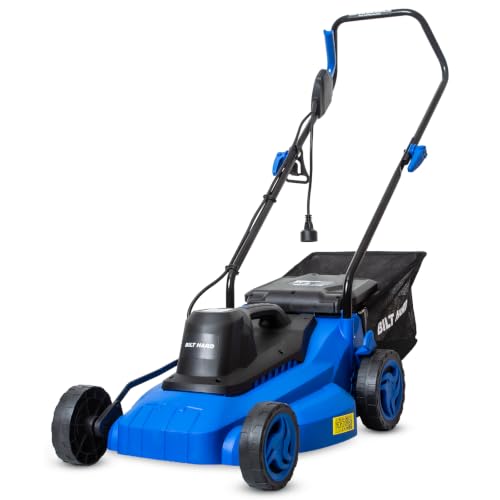
POWERFUL 11A MOTOR & 3300 RPM PERFORMANCE: Experience consistent, high-torque cutting power with our 11A motor reaching 3300r/min. Designed for efficient lawn maintenance, it delivers a clean, professional cut for small to medium yards without the hassle, fumes, or maintenance of gas-powered equipment.
Seasonal Mowing Frequency & Lawn‑Height Adjustments
Seasonal mowing hinges on matching frequency and height to each growth phase, so you’ll adjust both as temperatures and daylight shift. In spring, mow weekly, keeping cool‑season grass at 4–5 cm; start at the lower end of the range and cut slightly lower for the first few passes to stimulate growth while maintaining soil moisture management. Summer calls for two to three cuts per month, raising height to 5–6 cm to shade soil, reduce evaporation, and lower lawn stress. Fall returns to weekly mowing, gradually lowering height to 2.5 in before frost, then spacing cuts to every 14 days as growth slows. Winter mowing is suspended, except for occasional mild‑weather trims no more than every 14 days, to protect root systems and prevent stress. Understanding growth zones helps fine‑tune timing and height for optimal lawn health. Proper soil aeration further enhances root development and nutrient uptake. Adjustments should also consider soil temperature trends to avoid cutting when the ground is still cold.
How to Keep Your Mower Blades Sharp for Accurate Cuts
When you notice ragged grass edges or a drop in mower efficiency, it’s a clear sign the blades have dulled and need sharpening. Follow a blade maintenance schedule that calls for sharpening at the start of the season, after 8‑10 hours of use, and at least twice per season or every 25 hours. Inspect each blade for bends, nicks, or dents before mowing; dull edges tear grass and increase engine load. Use effective sharpening techniques: secure the blade, then apply a metal file or sharpening stone in a single, forward stroke at the 45‑degree angle, never back‑and‑forth. Remove burrs from the backside, test balance on a nail or with a balancer, and adjust material on the heavier side until vibration‑free. Disconnect the spark plug before any work. Use a blade stop tool to keep the blade from rotating while you sharpen. Remember that blade material determines how often sharpening is required. For optimal results, consider a bench grinder to quickly restore the cutting edge. Following the proper safety precautions, such as wearing safety glasses and securing the blade in a bench vise, helps prevent injuries during the sharpening process.

Brushless Motor for Powerful Performance: SporGain mower blade sharpener tool is equipped with a high-performance brushless motor, this lawn mower blade sharpener provides stronger power, lower noise, and longer lifespan than traditional motors, delivering smooth and efficient sharpening for lawn mower blades
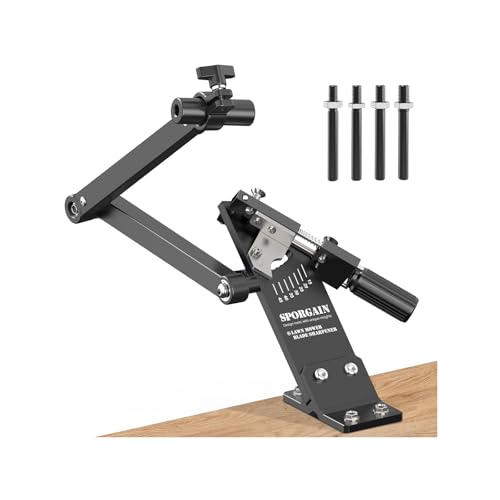
[ Updated ] Lawn Mower Blade Sharpener: SporGain mower blades sharpener suitable for Blades standard straight, mulching and high-lift mower.

The lawn mower blade sharpener is made of brown corundum, which has high durability and is not easily melted at high temperatures, making it suitable for long-term use.
Decide When to Mulch, Bag, or Remove Grass Clippings
If you’re deciding whether to mulch, bag, or remove clippings, start by evaluating lawn height, moisture, and health conditions; then match the method to the data. Mulch when grass sits 3‑4 inches tall, moisture is adequate, and the lawn is disease‑free; fine clippings decompose quickly, returning roughly 25 % of nitrogen and supporting pesticide‑free lawns. Bag clippings under wet conditions, during disease outbreaks, or when height exceeds the one‑third removal rule; collect bags for composting clippings to avoid landfill waste. Side‑discharge works on dry, sub‑4‑inch turf, scattering material evenly while suppressing weeds. Remove clippings if fungal spots, herbicide residues, or excessive length (>1 inch) appear; this prevents pathogen spread and prepares the lawn for seasonal height adjustments. Proper post‑mowing watering enhances root depth and reduces stress, helping the lawn recover more quickly.

Replacement model: 954040501, 960710005, 583207101, 532136420, 5321983-83, 532198383, 134079, 136420, 198383, 917255691, 917255694, 917255693, 917286260

COMPATIBLE BAGGER FOR MOWERS: For Poulan, Poulan Pro, Ariens, brute, Craftsman, Dixon, Husqvarna, McCulloch, Murray, Poulan Pro XT, Poulan XT, Southern States, Weed Eater and Yard King

We have chain stores in the local area (42 states) that can quickly transport your products, and all products come with a one-year warranty!
Common Lawn‑Height Mistakes & How to Fix Them
Although many homeowners think any height will do, cutting the lawn too short, ignoring seasonal adjustments, removing more than one‑third of the blade, using the wrong height for the grass type, and sticking to a fixed mowing pattern are the most common height‑related mistakes that weaken turf and invite weeds. To fix them, calibrate your mower to the species‑specific optimum—tall fescue 3‑4 in., Bermuda 0.5‑1.5 in., Kentucky bluegrass 2.5‑3.5 in., etc.—and adjust each season: raise in summer, lower in spring, moderate in fall. Never cut more than 33 % of blade length; let grass grow to that threshold before the next pass. Vary your mowing tracks to prevent compaction, and apply proper edging techniques while avoiding mowing mistakes that create uneven crowns or ruts. This systematic approach sustains root depth, reduces water demand, and suppresses weeds. Cutting at 2 inches or below requires a reel mower and frequent mowing.

⚠️This push reel mower has a maximum width of 23 inches and a working width of 16 inches.

SCISSOR-LIKE CUT: No ripping or tearing of grass blades for a better and healthier lawn

Products are all 100% NEW and Made with the Highest Quality Components Available with a Full One Year Warranty. Please verify your OEM part number from your original unit to help ensure fitment.