

You should stop mowing warm‑season grasses once nighttime temps dip below 50 °F, because respiration outpaces photosynthesis, chlorophyll breaks down, and growth stalls, making cuts ineffective and opening doors for disease. In northern zones (3‑6) the last cut falls in late October‑early November; in shifting zones (6‑8) you quit when the grass hits 55 °F while cool‑season stays stay under 50 °F; southern zones (8‑11) keep mowing until night temps near 10 °C, except high‑elevation sites that revert to early October. Cutting on wet grass tears blades, spreads fungi, clogs the mower, and compacts soil, while mid‑morning (8‑10 a.m.) or late‑afternoon (4‑6 p.m.) offers the cleanest cuts and minimal stress. Keep mower height at 3‑4 in. for warm‑season, never remove more than a third of the blade, sharpen blades, and finish at least a week before the first frost. Continue on to uncover the precise monitoring steps that tell you exactly when your lawn is ready for its final stop‑mowing.
Why Warm‑Season Grasses Stop at 50°F?
When soil temperature drops below 55 °F, warm‑season grasses enter physiological dormancy because respiration outpaces photosynthesis, enzymatic activity plummets, and chlorophyll degrades, leading to uniform browning. Below 50 °F, the slowed growth rate becomes pronounced as carbohydrate conversion to starch ceases and cellulose synthesis stalls. Enzyme complexes lose catalytic efficiency, so nutrient mobilization shifts from shoot to root reserves, conserving energy for winter survival. Species such as Zoysiagrass and St. Augustinegrass halt elongation at this threshold, while Bahiagrass and Bermudagrass exhibit similar cessation patterns once soils stay under 50 °F. The dormancy is reversible: when soil warms above 65 °F, photosynthetic capacity rebounds, respiration balances, and growth resumes with renewed nutrient mobilization. St. Augustinegrass rarely produces viable seeds and is primarily propagated vegetatively through sod, plugs, or sprigs, making seed production a limited reproductive pathway. Bermuda grass typically sprouts within 7‑14 days after planting under optimal warm temperatures and adequate moisture. Selecting a suitable variety based on climate compatibility can further improve establishment success.

HEAT TOLERANT GRASS SEED - Our cool-season grass seed mix contains tall fescue and Texas bluegrass. This turfgrass mix performs best in full sun to lightly shaded growing conditions and has the ability to tolerate heat up to 100°F.
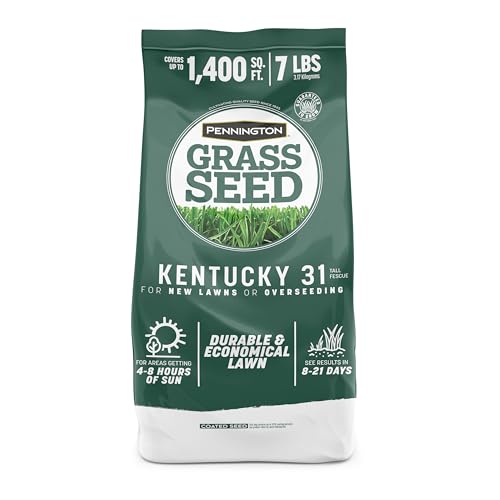
A grass seed for lawns that grows thick blades of grass that stand up to hot summers and heavy rains

ESTABLISHES NEW YARDS & FILLS IN BARE SPOTS - Black Beauty Ultra Grass Seed quickly germinates for the fast establishment of newly seeded lawns. It also rapidly fills in bare spots to invigorate thin or damaged lawns.
Which Regional Zones Change the Stop‑Mowing Date?
Most regional zones shift the stop‑mowing date in response to soil temperature thresholds and frost timing, so you’ll need to adjust your schedule according to whether you’re in a northern, intermediate, or southern climate. In northern zones (3‑6) soil temps below 50 °F trigger the last cut in late October to early November; microclimate variations can extend cool season grasses growth a week in sheltered valleys. Shifting zones (6‑8) blend cool‑ and warm‑season species, so you stop when the warm‑season component hits 55 °F and the cool‑season component stays under 50 °F, typically late October to mid‑November. Southern zones (8‑11) keep warm‑season lawns active until nighttime temps hover near 10 °C, pushing the final mow to early‑mid‑December; high‑elevation sites revert to early October thresholds due to rapid frost onset. Understanding soil temperature trends can help pinpoint the optimal cessation time. Proper irrigation can also support root development during the transition period, especially when water retention is low. Maintaining a slightly higher grass height before winter can reduce the risk of snow mold.
What Risks Come From Mowing Wet Grass Early?
Mowing wet grass early can throw your lawn into a cascade of problems, starting with uneven cuts that tear blades instead of slicing them cleanly. The water‑laden foliage bends, so the mower rips, creating jagged wounds that become entry points for fungi. This triggers increased disease spread: brown patch, pythium, leaf spot, and red thread exploit the open tissue, while clippings cling to the deck and ferry spores to fresh growth. Wet clumps also clog the mower, causing overheating and frequent stoppages. Soil compaction follows as the soft, saturated ground compresses under the machine, limiting oxygen and drainage. Heightened safety risks emerge from slippery surfaces, electric shock potential, and the need to manually clear jams, raising injury odds. Together, these mechanisms degrade lawn health and operator safety. Slippery surfaces increase the chance of slips and falls. Properly drying the mower after use helps prevent electrical hazards and prolongs its lifespan. Wearing protective gear such as sturdy shoes and eye protection further reduces the risk of injury. Mowing in rain can also accelerate fungal colonization due to prolonged leaf wetness.

Double Drawstring Design: Features a unique double drawstring bottom for easy use, providing a tight, secure fit on your lawn mower.

Keeps dirt and grass from sticking to mower decks and snow from sticking to snowblowers, shovels, plows and other snow equipment

Consistent professional results: achieve precise trimming with the lawn mower blade cover shield, every grass cutter blade protector maintains high performance across challenging landscaping jobs,lawn mower blade protector,blade cover for lawn mower
Best Fall Mowing Times: Mid‑Morning or Late‑Afternoon?
You’ll find that the best window for fall mowing falls between 8 a.m. and 10 a.m., when dew has evaporated and temperatures are still modest, delivering dry blades that cut cleanly and recover quickly. In these peak mowing conditions, moisture content is low, so the cut is precise and the turf experiences minimal stress. Mid‑morning also aligns with ideal mowing frequencies, allowing a full daylight recovery period before evening humidity returns. Late‑afternoon (4 p.m.–6 p.m.) offers a secondary option; the sun is lower, heat stress drops, and the grass can still dry before nightfall. However, residual midday heat may slow regrowth, making late‑afternoon viable only when mornings are unavailable. Choose the slot that guarantees dry blades and prime recovery. Cutting twice per week promotes healthier grass. Understanding grass growth cycles helps schedule these optimal mowing windows. Proper soil temperature monitoring ensures the grass is not stressed by cold ground conditions. Adjusting mower speed to match blade sharpness can further improve cut quality and reduce turf damage.

VERSATILE – The most versatile sharpener in the market to sharpen and hone both single and double beveled blades including knife, mower blade, pruner, loppers, hedge shears, axe, machete, hatchet, scissors, edged tool, etc.

3-In-1 mower blade for mulching, bagging and side discharging
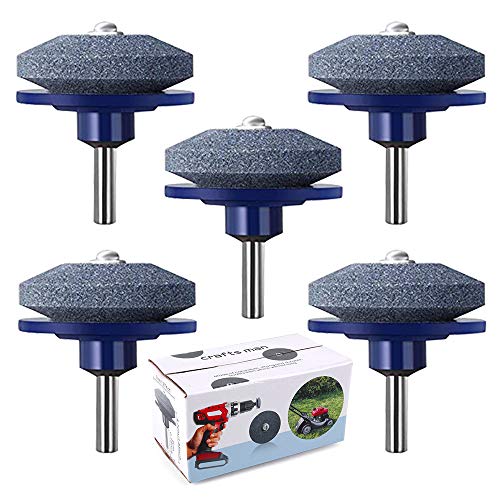
Lawn Mower Blade Sharpener : The new version of the Lawn Mower Blade Sharpener is Made of corundum, it solves the base wear caused by the excessive speed of grindstone, and effectively prolongs the service life and improves the use effect of the product. Our lawn mower blade sharpener is provided by the original factory, and it is guaranteed.
Pre‑Winter Cutting Rules for Stop‑Mowing: Height, Frequency, Blade Sharpness
After securing the ideal mid‑morning or late‑afternoon window, shift focus to the pre‑winter cutting rules that dictate height, frequency, and blade sharpness. Set your mower to 2‑2.5 in. for cool‑season grasses or 3‑4 in. for tall warm‑season varieties, never dropping more than a half‑inch per pass. Cut no more than one‑third of blade tissue each session and limit reductions to one notch on the deck. Schedule the final mow at least a week before the first frost, when temperatures sit below 50 °F and growth has ceased. Conduct thorough equipment inspections; sharpen blades to avoid ragged cuts that invite disease. These steps integrate winter protection strategies, preserving root health, reducing snow‑mold risk, and ensuring a resilient lawn through dormancy. Remember to drain fuel before storage to prevent engine damage. Sharpened blades also promote a cleaner cut, which helps the grass retain moisture and resist disease. Using a bench vise while sharpening ensures the blade stays firmly in place for a consistent edge.

Brushless Motor for Powerful Performance: SporGain mower blade sharpener tool is equipped with a high-performance brushless motor, this lawn mower blade sharpener provides stronger power, lower noise, and longer lifespan than traditional motors, delivering smooth and efficient sharpening for lawn mower blades
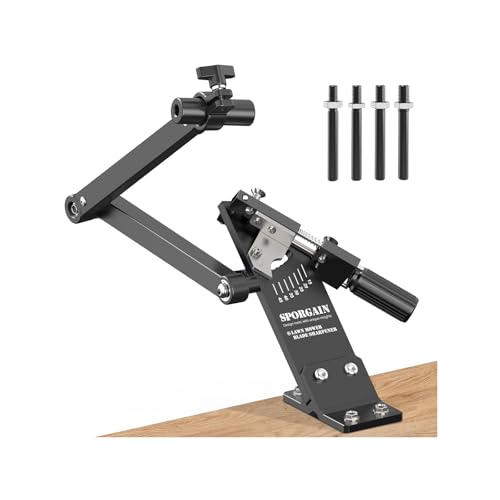
[ Updated ] Lawn Mower Blade Sharpener: SporGain mower blades sharpener suitable for Blades standard straight, mulching and high-lift mower.

Compatible with Most Angle Grinders: The mower blade sharpener equipped with 4 different guide pins, this lawn mower blade sharpener is compatible with most angle grinders. The precise fit between bushings and guide pins reduces wobble and ensures more stable and accurate sharpening.
How to Tell When Your Lawn Is Ready for Its Final Stop‑Mowing
Watch the temperature dip and the grass stop stretching; when daytime highs stay under 50 °F for cool‑season varieties (or under 40 °F consistently) and soil readings fall below 50 °F, growth fundamentally halts. Record the last mowing date, then check daily for color shifts toward a duller, bronze hue—an indicator of metabolic slowdown. Measure blade sharpness by feeling the edge; dull blades leave ragged cuts, confirming dormancy. Cross‑reference three‑day temperature trends: if air and soil stay below threshold, frost warnings predict the first hard freeze within a week, schedule the final cut just before that event. Avoid premature mowing, which can trigger regrowth; instead, let the lawn rest, preserving root health for spring emergence. Gradually reduce the mowing height following the one‑third rule to ease the lawn into dormancy. Understanding soil temperature fluctuations helps pinpoint the exact moment growth ceases. Adjust watering frequency based on soil moisture levels to prevent over‑watering during dormancy.

[Compatible Greenworks 80V Mowers] : 2550702, 2550402, 2501202, 2500402, 1356602, 1356702, 1356402, 1356502, 2533902, 2541302, 2533402, 2533602, 2502202, 2506902, 2515902, 2534102, 2502402NV, 2533302, 2541202

Universal Blade Removal Tool, Holds Blade In Place For Faster, Safer Removal, Fits All Walk Behind and Riding Mower Decks To 42"

Includes 1 universal replacement for 21 in. cut mowers