
Pick a sprinkler that fits your garden’s size, shape, and terrain. For lawns over 4,000 sq ft, use impact or traveling heads; medium zones (1,000‑4,000 sq ft) work best with rotary or oscillating models, and small areas under 1,000 sq ft benefit from stationary or bubbler units. Match pressure to head type—pop‑ups thrive at 30‑40 PSI, rotors at 40‑50 PSI, impact heads need 50 PSI+. Consider radius (pop‑ups 10‑15 ft, rotors 15‑50 ft) and wind resistance; impact and gear‑driven rotors minimize drift. For sloped or irregular beds, install check‑valve heads and micro‑spray nozzles, or switch to drip irrigation for precise, low‑runoff watering. The next section explains how to fine‑tune spacing and arc settings for most favorable coverage.
Match Sprinkler Types to Garden Size and Shape
When you match a sprinkler to your garden’s size and shape, the key is to align coverage patterns with the area’s dimensions. For large yards over 4,000 sq ft, select impact or traveling sprinklers; their rotating heads and mobile units produce broad, circular spray pattern customization that can be tuned to cover up to 3,000 sq ft per pass, eliminating dry spots and supporting water conservation strategies through uniform distribution. Medium lawns between 1,000‑4,000 sq ft benefit from rotary or oscillating models, which let you adjust radius and rectangular spray pattern customization for square or rectangular plots, reducing evaporation and runoff. Small spaces under 1,000 sq ft require stationary or bubbler units; fixed circular or square spray pattern customization and low‑pressure delivery target plant roots while minimizing waste. The Lawn Tractor Sprinkler can cover up to 14,000 sq ft with a 200 ft hose, making it ideal for extensive lawns. Proper head spacing ensures each zone receives adequate flow without exceeding pressure limits. Regularly check spray patterns for uneven distribution to maintain consistent watering throughout the season. Understanding battery lifespan helps you schedule maintenance and avoid unexpected downtime.

Wide Area Lawn Coverage: The Orbit Tripod Lawn Zinc Impact Sprinkler delivers powerful irrigation with a full 360-degree water distributor to help maintain healthy lawns

Landscape Watering Device: Traveling sprinkler travels up to 200 feet with an impressive 13,500 square feet of coverage, ensuring your entire lawn gets the hydration it deserves

Automated Lawn Coverage: The Orbit Traveling Tractor Water Sprinkler delivers hands-free irrigation using a traveling sprinkler design that moves along the hose path as a water powered lawn tractor
Evaluate Sprinkler Types: Pressure, Radius, and Wind
Matching a sprinkler’s coverage to your garden’s dimensions sets the stage for evaluating how pressure, radius, and wind affect performance. You’ll need precise pressure regulation: pop‑ups thrive at 30‑40 PSI, impact heads demand 50 PSI or more, and rotary heads operate best between 40‑50 PSI. Radius dictates placement—bubblers cover a 5 ft diameter, pop‑ups reach 10‑15 ft, rotors span 15‑50 ft, while spray heads max out at 15 ft and require head‑to‑head overlap. Wind resistance matters; impact and gear‑driven rotors minimize drift, and squirt jets stay steady in gusts. Match low‑pressure options (bubblers, spray heads) to small zones, and reserve high‑pressure impact or traveling heads for large, windy expanses. Guaranteeing these variables ensures uniform distribution without dry spots or plant damage. Proper trench depth prevents damage from soil compaction and maintains consistent water flow.
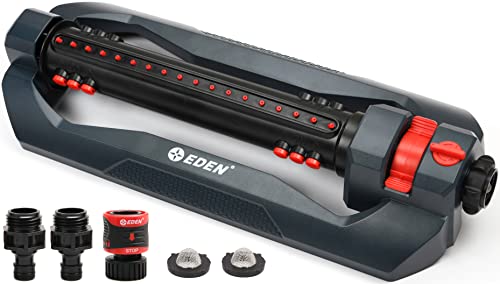
18 precision nozzles provide maximum coverage of large lawns and gardens .Quick Connect Starter Set for quick connection and disconnection fits standard U.S. garden hoses and watering tools. The secure twist-and-lock mechanism prevents accidental disconnection and water stop feature allows tool changes with the water on.Used for Garden & Lawn

3 PACK SPRINKLER SET: Includes three fully adjustable spike sprinklers for customized watering throughout lawns, gardens, and landscape areas

16 clog-resistant spray nozzles provide even watering with coverage up to 4,069 sq. ft. (378 sq. m.) in a compact design
Compare Pop‑Up, Rotor, and Fixed Sprinkler Types for Uniform Watering
A well‑designed irrigation layout starts with choosing the right sprinkler type for uniform watering, and each option brings distinct performance traits. Pop‑up heads give tight, adjustable arcs that excel on small to medium lawns; their 15‑30 psi operation limits mist, boosting water usage efficiency while keeping installation simple. Rotors, especially gear‑driven models, sweep 18‑55 ft radii at 25‑75 psi, delivering a rotating stream that smooths out precipitation variance across larger zones, which enhances uniformity but requires higher pressure. Fixed sprinklers emit a constant fan, ideal for ground‑cover or shrub beds where a non‑rotating pattern suffices. With respect to operating life expectancy, pop‑ups need frequent nozzle swaps, rotors typically last 12‑15 years with minimal upkeep, and fixed units inherit the pop‑up lifespan when paired. Choose the type that matches your area’s size, pressure envelope, and maintenance cadence. Impact sprinklers use the same pop‑up body as spray heads. Regularly check spray distribution to confirm even coverage across the lawn. Properly adjusting the head’s arc setting ensures each zone receives the intended water volume. Before any removal, be sure to depressurize the system to avoid accidental spray bursts.

ADJUSTABLE ARC & SPRAY DISTANCE: Includes a preinstalled 3.0 GPM nozzle with an arc that adjusts from 40° to 360°, ideal for both full and part circle coverage. Delivers a spray distance of approximately 22 to 52 feet, with optional nozzles (sold separately) allowing further customization.
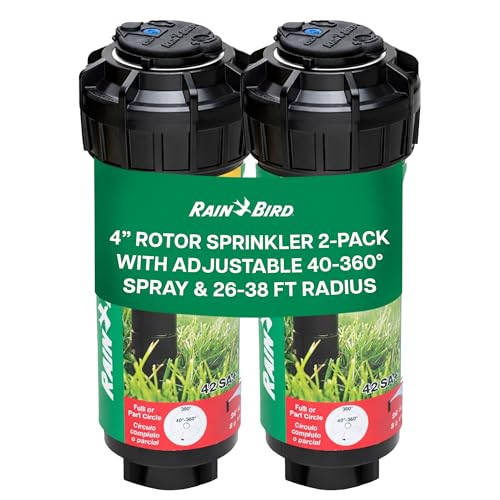
Professional Gear-Driven Rotor Sprinkler Head - The Rain Bird 42SA+ (W42003HC) heavy duty simple adjust gear-driven rotor sprinkler is designed as an in ground sprinkler head solution for medium to large lawn zones. It features an adjustable 40 - 360 degree part-circle and reversing full-circle rotation pattern and a 26 - 38 ft spray distance to deliver consistent, even irrigation coverage.

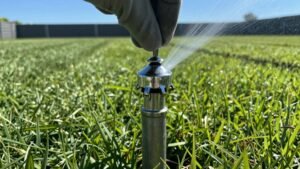
Arc adjustments from 40degrees to 360 degrees can be made quickly with a few twists for the turret – no tools required
Decide Between Sprinkler Types and Drip Irrigation for Each Garden Area
Which system best fits each garden zone depends on its function, layout, and water‑use goals. For expansive lawns, choose sprinklers; their broad spray and zoned heads deliver uniform coverage quickly, keeping energy efficiency high when paired with smart controllers. For vegetable beds, flower borders, or raised containers, install drip irrigation; its low‑pressure emitters target roots, slashing runoff and evaporation, which improves environmental impact and boosts yields by 20‑30 %. On sloped or irregular terrain, drip’s precise flow reduces erosion, while sprinklers excel on flat turf where rapid deployment matters. Balance operating costs by matching each area’s water demand: sprinklers for open grass, drip for plant‑specific zones, ensuring both water savings and minimal ecological footprint. 90% water efficient drip systems also help conserve scarce resources in drought‑prone regions. simple hose repair techniques can be used to fix any leaks in the irrigation lines before installation. Properly seal connections prevents future leaks and maintains system pressure. Adding a cap sprinkler head can further reduce water waste by limiting flow to needed zones.

NO MORE HARD INSTALLATION - SET UP IN MINUTES. Tired of struggling with stiff barbed fittings? This drip irrigation system features quick-connect fittings that let you push, lock, and secure tubing effortlessly. No tools, no leaks, just a smooth setup experience. Enjoy a frustration-free installation and get your garden watering system running in minutes.

Unique Design: 1/4" drip emitter ensures wide water passages, large deep and wide cross-section that improves clogging resistance for Garden Pots, Trees and Shrubs
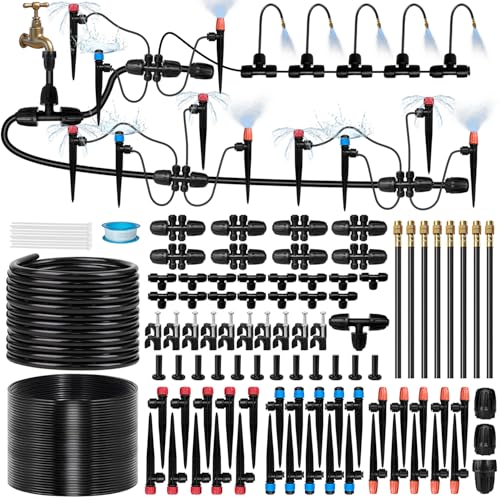
【Upgraded Tube Design & Water Saving】 Our garden watering system is upgraded to 1/2” diameter to support high water pressure. The 1/2” tee connector allows seamless splitting into 2 independent zones for customized watering schedules. By delivering moisture directly to root zones, this drip Irrigation system significantly reduces evaporation and runoff—saving more water compared to conventional sprinklers while eliminating the need for manual watering.
Install and Adjust Sprinkler Types on Slopes and Irregular Layouts
When you lay out sprinklers on a slope, you’ll first want to set the heads with check valves to stop low‑head drainage and puddling, then choose rotary nozzles that deliver water slowly—typically 0.4–0.8 in/hr—to match the soil’s infiltration rate and curb runoff. Align each head according to slope orientation, positioning low‑angle trajectory nozzles at the top to limit throw radius. Run pipe lines across the gradient, not downhill, to keep pressure consistent, and stagger lateral spacing for top, middle, and bottom rows. For irregular layouts, select precision micro‑spray heads with adjustable triangular patterns, and place bubbler emitters for shrubs. Fine‑tune arc, radius, and soak cycles to respect soil drainage conditions, ensuring uniform coverage without wet‑dry seams. Raising the sprinkler head can improve coverage on uneven terrain by increasing the spray distance and reducing low‑pressure spots, especially when using a sprinkler head adjustment screw. Adjust the spray pattern using the adjustment screw to achieve consistent distribution across the slope. Properly calibrating water pressure helps prevent uneven watering and promotes healthier grass.

Approved for sale/meets pressure regulation legislation requirements in: CA, CO, HI, VT, MA, ME, NY, OR, RI, WA, and Washington DC


Works with Eden sprinklers featuring “H”-shaped bases and tripod bases or connects to 3/4” PVC female threaded pipe connections. Easy to attach with no special tools required