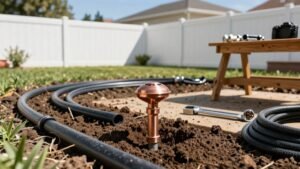

Turn off the main valve and bleed the lines, then dig away the sod to expose the collar and old head. Unscrew the faulty head using a sprinkler wrench, wrap the riser threads with 1/4‑inch Teflon tape, and apply a small amount of thread sealant. Hand‑tighten the new head, set its height and angle for the desired spray radius, and test the system, adjusting the arc as needed. Finally, backfill the hole, restore the sod, and watch the first cycles for even coverage—more details follow if you keep going.
Why Your Sprinkler Head Needs Replacing
You’ll notice a sprinkler head needs replacing when physical damage, misalignment, or wear compromises its function. Cracked or snapped heads from lawnmowers, foot traffic, or vehicles leak at the base, and tilted heads spray onto streets or fences, indicating misalignment. Soil settlement, freeze‑thaw cycles, and poor placement near edges accelerate sinking or shifting, causing uneven coverage and lawn browning. Leaking heads waste hundreds of gallons weekly, inflating utility bills and risking drought‑restriction fines. Springs lose tension after 5‑7 years, diaphragms crack, and solenoids fail, leading to under‑pressurized zones and system‑wide degradation. Identifying frequent maintenance patterns—repeated head failures in a single spring—signals broader wear. Addressing future system upgrades early prevents costly replacements and guarantees reliable water distribution. Remember to fully depressurize the system before any work, as this prevents accidental spray and protects both the user and the lawn. Properly shutting off the water supply also helps avoid pressure spikes that could damage other components.
Gather the Tools and Materials for a Quick Swap
Where do you start when swapping a sprinkler head? First, gather hand tools: a sprinkler wrench, pliers, a screwdriver, a stiff brush, and Channellock pliers. Add digging tools—small shovel, trowel, pull‑up tool, butter knife, and custom aluminum removal tool—to expose the fitting. Include measuring tools: tape measure, knife, and screwdriver for alignment. Then, source replacement parts: matching sprinkler heads, tapered risers, pipe thread sealant, and extra soil or sand. Prepare cleaning items: a damp rag, water cup, aluminum sheet, belt sander or mill file, and a drill for custom tool holes. Keep this inventory organized and store essential tools in a dedicated box, ensuring quick access for each swap. This structured kit minimizes downtime and guarantees precise installation. DIY replacement can save $75‑$150 compared to hiring a professional. Properly selecting the head location helps achieve uniform coverage and prevents over‑watering in critical zones. Remember to check the water pressure rating of the new head to avoid system overload.

ADJUSTABLE ARC & SPRAY DISTANCE: Includes a preinstalled 3.0 GPM nozzle with an arc that adjusts from 40° to 360°, ideal for both full and part circle coverage. Delivers a spray distance of approximately 22 to 52 feet, with optional nozzles (sold separately) allowing further customization.

Smart Irrigation Starts Here - The Rain Bird 1804VAN 1800 Series Pack of 5 features 4-inch pop-up sprinkler heads with a fixed spray, variable arc nozzle and 1/2 in. female threaded inlet, made in the USA and built for precise irrigation in lawns, garden beds, and landscaped areas in residential and professional systems.
Turn Off Water and Ensure Sprinkler‑System Safety Before Digging
Turn off the water by locating the sprinkler system’s shut‑off valve—usually a blue‑tagged ball valve near the main supply line—and rotating its handle perpendicular to the pipe; this 90‑degree turn stops flow to the irrigation network while leaving the rest of the house supplied. Verify the valve is fully closed by opening an exterior tap; residual pressure should drop quickly. Inspect the backflow preventer; each internal ball must also be turned 90 degrees to isolate the system. Before you dig, check local regulations for any additional permits and notify utility companies at least two business days in advance, as required by law. Call 811 for an underground service alert, and keep the notification on file for the 28‑day validity period. This guarantees safety and compliance before excavation. Drain above‑ground pipes by opening the bleed valves in the sprinkler valve box to release any trapped water. Properly setting the sprinkler head’s throw radius ensures even coverage and prevents dry spots. Loose fittings can cause rotation problems if not tightened before testing.

Body & Ball Type:Full Port, Low Operation Torque,316 Stainless Steel

Body & Ball Type:Not full port,low operation torque

PACKAGE INCLUDES: 1 x 1-1/4inch Ball Valve Handles + 1 x M12 Nuts.
Expose the Old Head Without Damaging the Riser
A few careful steps will let you expose the old sprinkler head without harming the riser. First, perform safe debris removal by pulling back turf and gently prying grass that has tightened around the embedded head. This clears the work zone and prevents accidental lawn damage. Next, locate the collar—the threaded connection between riser and head—by visual inspection; confirming proper head orientation helps you identify the correct turning direction. Apply the dual‑tool leverage technique: grip the top of the head with one plier while rotating the collar with a second tool, maintaining firm contact on the riser to keep it stationary. Rotate gradually until the collar is fully loose, ensuring the riser stays stable and ready for the subsequent removal phase. Old heads may be deeply embedded after many years of use, requiring careful prying to avoid damage. Properly assess the spray pattern to determine the needed arc adjustment for uniform coverage. Verify that the replacement head meets the flow rate specifications for your irrigation system. Remember to shut off the main water supply to prevent accidental pressure spikes while working.
Remove the Faulty Sprinkler Head Safely
Before you start removing the faulty head, shut off the irrigation supply at the main valve or zone controller to eliminate pressure and prevent water spray. First, determine rotation orientation by feeling the head’s base; most heads unscrew counter‑clockwise. Use a hand‑held sprinkler adjustment tool or your fingers to begin turning. If the head resists, apply a wrench or pliers lightly, but avoid excessive force that could strip the riser threads. Once the head loosens, continue rotating until it separates from the riser, then set it aside. Inspect the exposed riser for cracks or worn splines; any damage means you’ll need to replace the riser before installing a new head. Finally, clear debris by flushing the line with a short burst of water and wiping the threads clean. The sprinkler head may have broken at the pipe junction due to mower pressure, so check for a cracked junction before proceeding. Properly aligning the new head ensures even coverage across the lawn. Adjusting the head height can improve water distribution and reduce runoff. Regular maintenance, such as checking for clogged no, helps prevent future blockages and keeps the system operating efficiently.
Prep the Riser Threads With Teflon Tape for a Leak‑Free Seal
After you’ve removed the faulty head and cleared the threads, wrap the riser threads with Teflon tape to guarantee a leak‑free seal. First, clean both male and female threads with a soft‑bristled brush, removing debris and old tape. Choose 1/4‑inch tape for 1/8‑to‑3/8‑inch threads; hold the tape’s edge at the pipe start, keeping it flat and parallel to the thread face. Apply the tape using the tape application technique: wrap clockwise—opposite the tightening direction—starting at the first thread, maintaining a taut pull. Leave the first thread exposed, then add two to three layers, about two and a‑‑revolutions each. This provides teflon tape benefits: fills minor imperfections, lubricates the riser, and creates a durable, leak‑free seal. Threaded fittings are a weak point in the system. Properly adjusted sprinkler heads ensure even coverage throughout the lawn.
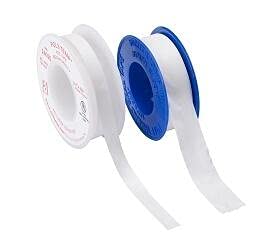
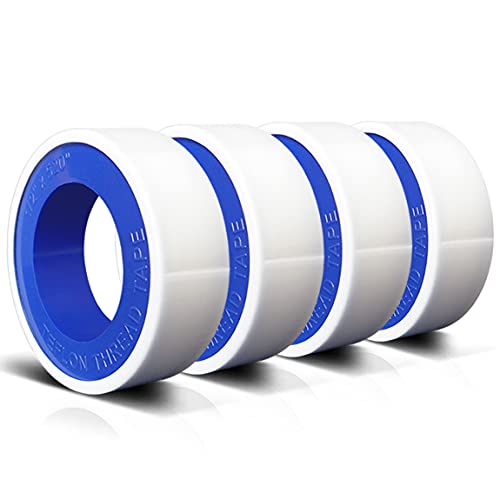
Teflon tape has a sealing function to prevent the leakage of water or gas.
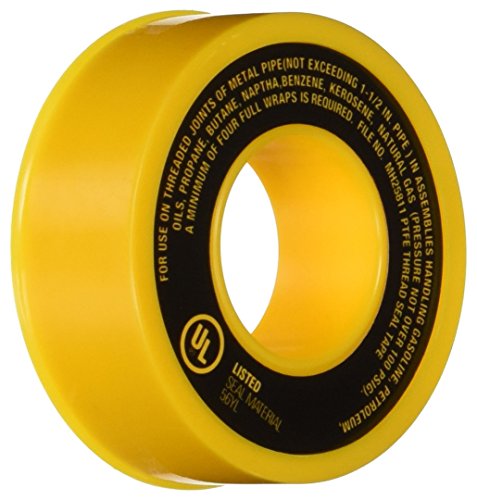
Yellow gas line thread seal tape with PTFE
Install the New Sprinkler Head and Align It Properly
Start by hand‑tightening the new sprinkler head onto the riser or T fitting until it feels snug, then finish with one to two clockwise turns using a sprinkler wrench or open‑ended wrench—never exceeding this limit to avoid over‑torquing. Next, position the head so its nozzle faces the intended spray direction; use a quarter‑turn while tightening to achieve the correct head angle adjustment. Verify that the head sits level with the surrounding soil and maintains a ½‑inch clearance from hard edges. After tightening, perform water flow monitoring by briefly activating the system and checking for leaks or irregular pressure. If any seepage appears, retighten within the one‑to‑two‑turn limit. Guarantee the orientation matches the layout before backfilling. Adjust the spray pattern using the adjustment screw to fine‑tune distance and coverage.

ROBUST DURABILITY - Premium Chrome Vanadium Steel head ensures our wrench set's toughness; heat-treated, drop-forged, and enhanced with corrosion-resistant black oxide finish.
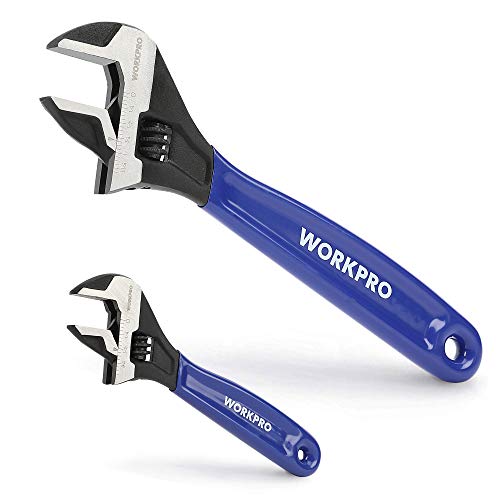
DUAL-SIZE SET FOR VERSATILE USE: This 2-piece set includes 6-inch and 10-inch adjustable wrenches, designed for everyday household tasks such as plumbing fixes, furniture assembly, bike repairs, and garage work. A great toolkit essential for DIYers and homeowners.

HEAVY-DUTY CONSTRUCTION : Made from heat-treated CR-V steel, this 3-Piece Adjustable Spud Wrench Set withstands demanding tasks with ease. The black oxide finish improves rust resistance, ensuring lasting durability for professionals and DIY users
Adjust Spray Pattern and Height for Even Coverage
One or two adjustments to the spray pattern and height can make all the difference between uniform watering and uneven patches. First, monitor water pressure; a steady 30‑50 psi range prevents erratic arcs. Then, adjust nozzle height using the pull‑up tool so the stem sits at the prescribed elevation—typically 2‑3 in. above the ground. For fixed heads, turn the top screw clockwise to extend the throw, counter‑clockwise to shorten it, and twist the stem to align the marked “L” point with the target zone. For gear‑driven heads, locate the radius screw and turn clockwise to reduce distance up to 25 %, then use the rotor tool to set the arc from 40° to 360°. After each tweak, run a test cycle, observe coverage, and fine‑tune until adjacent heads overlap by 2 ft without dry spots. Sprinklers often miss areas due to misalignment. Proper head selection is crucial because using a pop‑up sprinkler with the correct spray radius ensures consistent coverage across the lawn. Understanding zone spacing helps balance water distribution and prevent over‑watering. Rotating heads can be calibrated by marking wet spots with a hose to achieve even coverage.
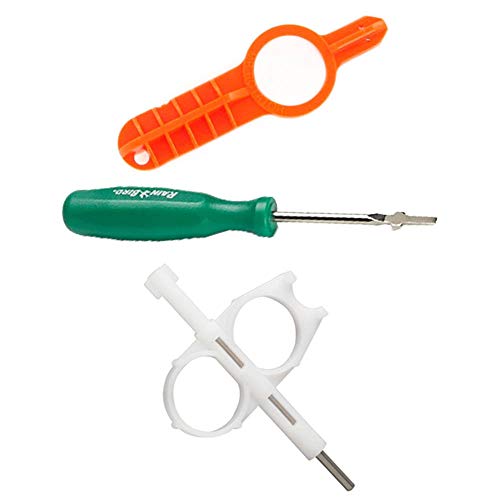
Hunter Key


The Hunter adjustment wrench consists of a 3/32 allen key, two convenient finger loops for gripping
Backfill, Restore Sod, and Watch the First Cycles
Backfilling the trench begins by returning the excavated soil around the sprinkler head, keeping the stem perfectly vertical, and gently tamping in layers until the surface is level with the surrounding lawn. Perform proper soil tamping in 2‑inch increments, checking that each layer stays firm but not compacted to the point of crushing roots. After the final layer, verify surface leveling; the ground should sit flush with the existing lawn without depressions. Replace sod by arranging harvested grass pieces in their original puzzle‑like order, filling any gaps with additional soil. Water the restored area heavily for two weeks, keeping the sod moist until roots re‑establish. During the first irrigation cycles, observe the head for leaks, rotation smoothness, and uniform spray, confirming that the backfill and sod restoration have succeeded. Using a trenching shovel ensures the soil is placed evenly and without damaging the new sprinkler head. Properly aligning the deck height using a carpenter’s level helps achieve consistent cutting across the lawn. Remember to wear protective gear while working to minimize injury risk.
Verify Coverage and Fine‑Tune the Spray Pattern
How do you confirm that the new sprinkler head delivers uniform water before the zone’s first full cycle? Begin with pressure monitoring: isolate the zone, shut off household fixtures, and verify steady pressure with a gauge. Then perform water collection testing by placing stake‑mounted cups at equal intervals across the zone. Run the zone for the prescribed time, then compare cup volumes; identical readings corroborate uniform coverage. If discrepancies appear, adjust the head’s arc or radius, clean debris, and re‑run the test. Observe the spray pattern for misting, puddling, or dry spots, and ascertain each head reaches its neighbor without overspray. After each tweak, repeat the catchment test until all cups collect the same amount, guaranteeing a fine‑tuned, even spray. Consistent water across the zone rules out coverage issues. Ensure the trench depth matches the recommended sprinkler head burial depth to maintain proper head operation.