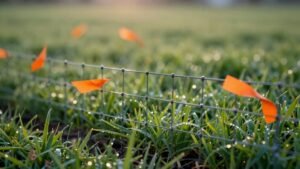

You can over‑seed, but you must calculate the exact rate—typically 2‑5 lb per 1,000 sq ft for Kentucky bluegrass and 5‑10 lb for tall fescue—so you don’t create a dense canopy that traps moisture and invites disease. Measure your lawn, apply the formula (sq ft × rate) ÷ 1,000, and adjust for sun or shade zones. Use a drop spreader, aerate, and keep soil consistently moist. If you follow these steps, you’ll avoid common pitfalls and keep your lawn healthy, and the next section shows how to fine‑tune the process.
What Is the Correct Seed Rate for Your Lawn?
How much seed should you actually put down? Start by measuring your lawn’s square footage, then apply the formula: (sq ft × rate per 1,000 sq ft) ÷ 1,000. For a new Kentucky bluegrass lawn, use 2‑5 lb per 1,000 sq ft; tall fescue needs 6‑10 lb; perennial ryegrass 5‑9 lb. Overseeding drops the rate roughly half. Warm‑season grasses vary: bermudagrass 1‑4 lb, centipede 0.5‑1 lb, buffalo 2‑3 lb, carpet 4‑5 lb. Choose high‑quality seed with good germination percentages and match seed size to the species. Apply evenly using a calibrated spreader, overlap rows slightly, and calibrate the machine for consistent seed application techniques. This guarantees the target of ~16 seeds per square inch without waste. Coated seed requires a slightly higher application rate due to its added inert coating. Understanding seed‑to‑acre conversion helps ensure you purchase the correct quantity for large lawns. Proper soil preparation can significantly improve germination success. The presence of essential minerals in the seed coating supports early root development.

Pennington Smart Seed contains just the right amount of fertilizer to help your lawn succeed
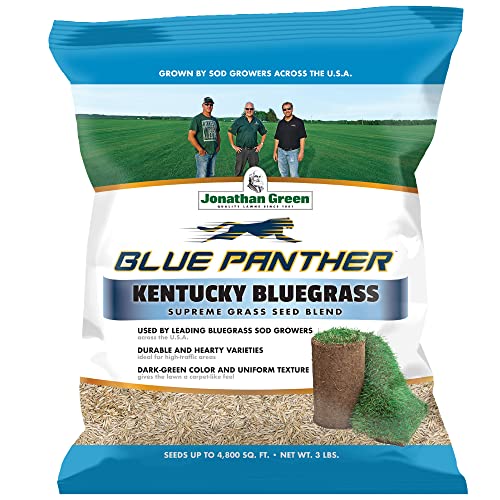
100% KENTUCKY BLUEGRASS GRASS SEED - Use our Blue Panther Kentucky Bluegrass Grass Seed when you want to keep a 100% KBG lawn or introduce KBG into an existing lawn. These bluegrasses are grown by leading sod growers across the USA.

Kentucky 31 Tall Fescue grass seed is the original turf for your home
Why Over‑Seeding Can Harm Grass Health and What to Watch For
You’ve nailed the right seed rate, but cramming too many seeds into the same spot can quickly turn a healthy lawn into a breeding ground for problems. Over‑seeding creates a dense canopy that traps moisture, limits airflow, and invites fungal diseases like brown patch, dollar spot, and Pythium blight. Those pathogens produce unsightly lawn damage—brown circles, straw‑colored spots, and greasy, water‑soaked patches. At the same time, the crowding forces seedlings to compete for water, nutrients, and sunlight, weakening vigor and causing accelerated lawn decline. Excessive thatch builds up from rapid organic matter, further reducing water penetration and root health. Watch for patchy discoloration, thick thatch layers, and persistent dampness as clear signs you’ve overseeded. Proper mulch depth and soil temperature are crucial for promoting uniform germination and protecting seeds from erosion. Planting grass seed at the recommended depth—typically ¼‑½ inch for most cool‑season grasses and ½‑¾ inch for warm‑season varieties—helps ensure optimal contact with soil moisture.
Choosing the Right Seed Density for Your Grass Type
Choosing the right seed density starts with matching the grass species to its ideal seeding rate, because each variety’s seed size and germination potential dictate how many pounds per 1,000 sq ft you’ll need. For cool‑season lawns, Kentucky bluegrass needs 2‑3 lb, fine fescues 4‑5 lb, and tall fescue 5‑9 lb; larger seeds like tall fescue and ryegrass demand higher rates, while small seeds such as bermudagrass require far fewer pounds but more seeds per square foot. Adjust for germination speed by calculating pure live seed (PLS): lower PLS means you must increase the rate. Plant at the proper seed depth—about ¼‑½ in. for most cool‑season grasses and ¼ in. for warm‑season varieties—to facilitate quick emergence and uniform coverage. Visual seed guide helps confirm seed shape and color before sowing. Soil pH also influences seed‑ling vigor and should be tested before seeding. Proper drainage is essential for preventing root rot and ensuring healthy growth.
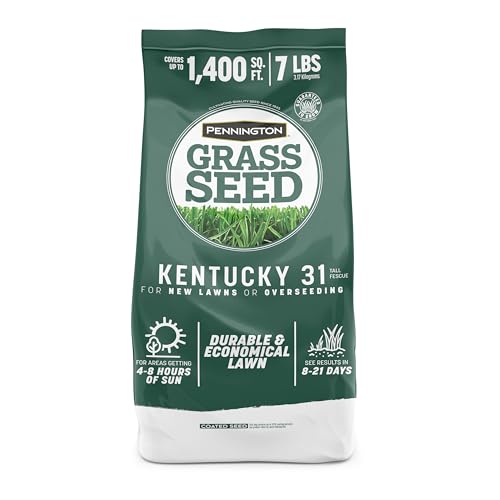
A grass seed for lawns that grows thick blades of grass that stand up to hot summers and heavy rains
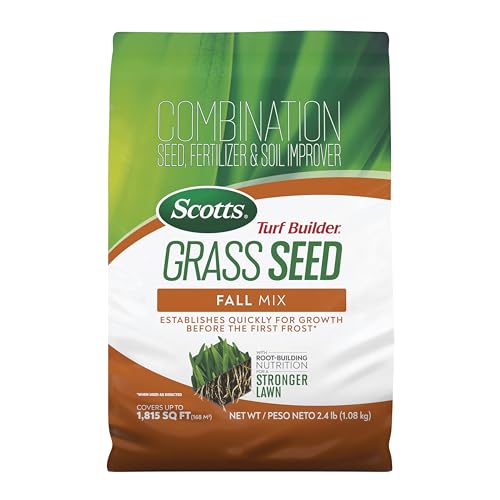
WHERE TO USE: This grass seed mix contains Kentucky bluegrass seed, perennial ryegrass seed, and creeping red fescue; it is designed for full sun and light shade, and has low drought resistance with medium durability

PERFECT FOR FALL SEEDING - Our cool-season grass seed mix is formulated for successful fall seeding projects. The grass seed varieties are bred to perform especially well when seeded during the fall planting season of mid-August through mid-October.
Step‑by‑Step Guide to Measuring and Applying the Correct Over‑Seeding Amount
Some quick math can keep your overseeding on track: first measure the lawn’s square footage, then apply the appropriate seed‑rate formula. Break the area into rectangles, multiply length by width, and add the totals. Use the formula (sq ft × rate per 1,000 sq ft) ÷ 1,000 to get pounds of seed. For Kentucky bluegrass, multiply by 1–1.5; for perennial ryegrass, 3–4; for tall fescue, 4–5. Before you seed, do a proper mower height adjustment and mow short. Schedule soil aeration timing right after mowing; aerify 20–40 holes per square foot, then drag to break cores. Apply seed with a drop spreader in overlapping passes, checking calculations to avoid waste or gaps. Proper soil preparation ensures better seed‑to‑soil contact for optimal germination. Consistent moisture helps the seed germinate evenly and reduces the risk of clumping. Properly timing irrigation after seeding promotes uniform germination and stronger root development.

OPERATION: Adjustable arm support on this seed, salt and fertilizer spreader helps provide maximum comfort

64-OUNCE BOTTLE: high-capacity poly bottle with a wide opening and easy screw top, quickly remove the lid to add your preferred seed, salt, fertilizer, etc. and simply screw back into place
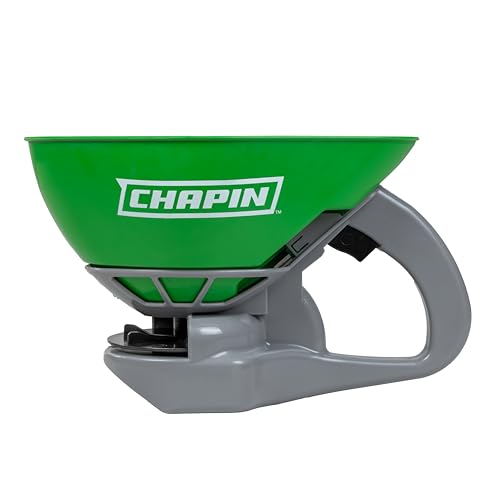
Chapin Garden Spreader: Designed for all your residential lawn and garden seed, pest control and fertilizer spreader need, this 0.3 Gal hand held broadcast spreader is weather-resistant, has a green poly hopper and ideal for smaller spaces
How to Adjust Over‑Seeding Rates for Sun‑Exposed and Shaded Zones
After measuring your lawn and calculating the total seed needed, you’ll need to split that amount between sun‑exposed and shaded zones and adjust each portion. For sun‑exposed thin turf, start with 3‑4 lb per 1,000 sq ft; increase to 5‑6 lb if the area is traffic‑worn or has bare patches, never exceeding 6 lb to avoid overcrowding. In shaded zones, halve the rate—about 2‑3 lb per 1,000 sq ft for fine fescues or turf‑type tall fescue—and reduce further for deep shade. Perform pre‑treatment steps like aeration in compacted shade before seeding. Use criss‑cross spreading patterns: one pass north‑south, a second east‑west, to verify even coverage and good seed‑soil contact. Adjust the spreader settings for each zone to match these rates. Proper timing of the overseeding ensures optimal germination and a resilient lawn. Planting in the early fall takes advantage of cooler temperatures and natural moisture. Choosing the right seed type for your climate maximizes establishment success.
Top 5 Over‑Seeding Mistakes and Simple Fixes
If you skip the basics, over‑seeding can backfire fast.
- Wrong timing – Plant cool‑season grass in fall or early spring, warm‑season in late spring/early summer. Mistimed sowing exposes seeds to temperature extremes and boosts weed growth, hurting your understanding of seasonal timing and minimizing weed competition. Soil temperature must be consistently 8‑10 °C for germination.
- Mismatched seed – Choose varieties suited to your climate and existing lawn. A warm‑season blend on a cool‑season base will struggle and invite weeds.
- Incorrect rate – Follow bag recommendations; too much crowds seedlings, too little leaves gaps for weeds. Overlap passes lightly to avoid excess.
- Improper watering – Keep soil consistently moist, not soggy. Light, frequent irrigation supports germination without rot. Light frequent watering helps maintain the ideal moisture level during the critical first two weeks.
- Poor soil prep – Remove debris, aerate, and mow low before sowing. Good seed‑soil contact reduces competition and promotes uniform growth.
Using Soil Tests to Fine‑Tune Your Over‑Seeding Quantity
Skipping the basics can turn overseeding into a costly mistake, but a soil test gives you the data you need to avoid it. Collect 10‑15 sub‑samples from across the lawn, 3‑4 inches deep, and mix them in a clean plastic container. Send the composite to a lab; the report will show pH, phosphorus, potassium, organic matter, and salt levels. Use soil nutrient monitoring results to set custom application rates for seed and fertilizer. If pH is off, adjust with lime or sulfur before seeding. Low phosphorus or potassium means you should boost those nutrients, but only enough to meet the test’s recommendations. By matching seed density to the soil’s actual capacity, you prevent waste and promote uniform germination. Annual testing ensures that any changes in soil conditions are caught early, keeping your lawn health on track. A simple germination test can also verify seed viability before you spread it. Store seed in a cool, dry place to maintain high germination rates over time. Proper soil temperature during germination can dramatically speed up seed sprouting and improve overall lawn vigor.

Kindly NOTE: This soil tester can not be applied to test pH value of any other liquid. If the soil is too dry the indicator will not move, and water it before testing.

Quick, at home results for Soil pH, Nitrogen, Phosphorous and Potash Innovative and inexpensive soil test kit features an easy-to-use capsule system and patented color comparators

KNOW BEFORE YOU GROW | Grow the healthiest, sustainable lawn and garden with the most accurate and easy to use professional soil test kit on the market
Why Adding Starter Fertilizer Keeps Your Lawn From Getting Over‑Seeded
A modest amount of starter fertilizer right at seeding does the trick of keeping your lawn from becoming over‑seeded. It supplies diluted nitrogen, phosphorus, and potassium that boost germination and root development without burning tender shoots. The extra phosphorus improves seed‑to‑soil contact, while quick‑release nitrogen accelerates tissue growth, letting each seed establish a strong root system. This vigor lets you achieve ideal seed density with fewer seeds, because seedlings fill gaps faster and compete evenly. Apply the fertilizer at the recommended rate (12.5 lb per 1,000 sq ft) directly on top of the seed, then water lightly to activate it. The result is a thick, uniform lawn that avoids the need for excessive seeding.

Grows new grass 70% thicker, 35% quicker versus unfed grass

GREAT FOR SEEDING & SODDING - Veri-Green Lawn Food for Seeding & Sodding is formulated to get new grass seedlings off to a great start. It helps your lawn grow strong roots and grow faster and thicker when seeding, overseeding, and laying sod.

WHEN TO APPLY: Apply pre-emergent weed killer plus lawn fertilizer to a dry lawn when temperatures are consistently between 60°F and 90°F for best results
How to Spot Over‑Seeding During Germination
Spotting over‑seeding early saves you time and resources, so keep an eye on the lawn as soon as the first shoots appear. Look for seedling density patterns that are uneven: some patches will be thick and matted while others stay bare. Excessive over seeding symptoms include yellowing or browning in crowded zones, persistent gaps, and weeds slipping through thin spots. If germination stalls in high‑density areas, seedlings may wilt or rot from waterlogged soil. Compacted, moist ground further slows emergence, leaving a patchy appearance. Watch for slow growth beyond the initial sprout stage and for frequent watering needs that differ across the lawn. Identifying these signs lets you act before the lawn becomes weak and uneven. Soil temperature must be consistently at 55°F or higher before overseeding.
When to Re‑Seed Over‑Seeded Spots for a Balanced, Healthy Lawn
Timing is everything when you decide to re‑seed over‑seeded patches, because the window for successful germination closes quickly once temperatures shift. Aim for early fall when daytime highs sit in the low‑mid‑70s and soil stays in the 50s; this gives seedlings 14‑21 days to establish before frost. If you missed fall, target mid‑April, counting back 2‑3 weeks from the last expected frost. First, measuring grass coverage lets you calculate the exact seed amount needed. Lightly rake the area, add a thin compost layer to sustain soil fertility, then spread seed at a modest rate—about 250 sq ft per pound for bare spots, less for overseeding. Water consistently, keep the top inches moist, and resume mowing only when the new blades reach 3‑4 inches. This schedule maximizes germination while preserving a balanced, healthy lawn. Seed‑to‑soil contact is essential for uniform emergence.