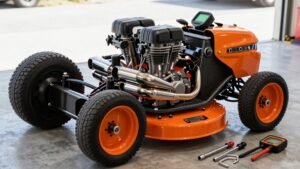

You’ll find that Edwin Budding patented the first practical lawn mower in 1830, adapting textile‑machine reels to cut grass. By the 1840s horse‑drawn sickle‑bars appeared, then steam‑powered models in the 1890s. Amariah Hills refined the reel in 1868, and John Albert Burr introduced the rotary design in 1899. Gas engines and Briggs & Stratton’s lightweight units sparked mass adoption in the early‑20th century, while robotic mowers now dominate the market—keep going to see how each breakthrough reshaped lawn care.
Edwin Budding’s 1830 Patent – From Cloth to Grass
The seed of Budding’s invention was planted in the bustling cloth mills of early‑19th‑century England, where he watched laborers wield scythes while he, a pattern maker at an iron foundry, tinkered with John Lewis’s napping machine. You’ll see that his inspiration from textile machinery came from the helical, later cylindrical, cutting blade that trimmed woven fibres. Translating that principle, Budding designed a 19‑inch steel cylinder pressed against a knife plate, driven by a large iron roller and gears, and added a second roller to set cutting height. He also integrated a clippings collection system, funneling grass trimmings into a bag. The August 31, 1830 patent, filed with Ferrabee of Phoenix Iron Works, codified this mechanical lawn‑cutting solution, merging cloth‑processing logic with outdoor maintenance. Budding’s invention also led to the development of the first adjustable spanner in 1842, a testament to his broader impact on labor‑saving tools. Modern string trimmers employ similar cutting principles, using rotating nylon lines to achieve precise grass control. The design of a cylindrical cutting blade cylindrical cutting blade allows the mower to maintain consistent contact with the grass, improving efficiency and cut quality.
Early 19th‑Century Lawn Mower Innovations: Animal‑Pulled and Steam‑Powered Models
When the 1830s gave way to a booming demand for larger, manicured grounds, innovators turned to animal power to extend the reach of lawn‑cutting machines. You’ll see that by the mid‑1840s horse‑drawn sickle‑bar mowers, originally crop harvesters, were repurposed for grass. Their wrought‑iron frames—chosen for durable materials—handled the pull of small horses, while the sickle blades sliced tall grass over six inches. The animal traction allowed wider paths, opening larger cutting areas for sports fields, cemeteries, and sprawling gardens. By the 1850s, reel‑blade designs emerged, first on estates and then in American factories, improving efficiency and edging out scythes. Steam power arrived in 1893 via James Sumner’s Lancashire model, coupling a boiler‑driven engine to the blades. Though powerful, the cumbersome steam unit required heavy maintenance, limiting its spread despite its ability to tackle massive lawns. The push mower was initially developed by Edwin Budding in the 1830s, featuring a heavy drum with blades that required manual pushing. Modern lawns often benefit from efficient water management to preserve both the turf and the surrounding ecosystem. Grass seeds, produced through pollination and fertilization, enable the propagation of diverse grass species across natural habitats. Birds eat grass seed can influence lawn health by reducing seed availability for new growth.

LAWN MOWER TOY: Husqvarna Toy Lawn Mower looks and sounds like a real Husqvarna HU800 AWD mower and is perfect for budding professionals

🚜 A REALISTIC ZERO-TURN LAWN MOWER ADVENTURE – This Kid Trax 12V Zero Turn Lawn Mower Ride-On Toy gives kids their very own tractor toy experience. The see-through translucent deck looks like it’s mowing grass, while the durable tires provide smooth performance across the lawn, making every ride feel authentic. It’s one of the most exciting outdoor toys and the best-selling lawn mower ride-on toy for kids who love to pretend. A great pick for birthdays, holidays, and unforgettable gifts.
Amariah Hills’ 1868 Reel‑Type Mower and Its Impact on U.S. Lawns
Although lawn‑care in the 1860s still relied on hand‑sickle and rudimentary reel mowers, Amariah Hills’ 1868 patent for a reel‑type mower transformed American grounds‑keeping. You’ll see how Hills opened the cylinder of the spiral cutter, added a height‑adjustable roller, and secured the handle with a novel attachment, turning a clunky English model into a practical U.S. tool. By 1867 his design entered production at the Curtis silver‑plate factory, and the 1871 Archimedean Lawn‑Mower Company launched the first large‑scale commercial success, targeting golf courses, parks, and cemeteries. The mower’s ability to cut four acres a day spurred demand, while the sale of patent rights to Caleb Talcott cemented Hills’ manufacturing innovations as a benchmark for later American reel mowers.
John Albert Burr’s 1899 Rotary Mower – A Blueprint for Modern Cutters
By 1899, John Albert Burr had already turned his steel‑working background into a breakthrough that reshaped lawn care: his rotary mower, granted on May 9, combined a spinning blade with fully enclosed gearing and traction wheels, eliminating the clogs and maneuverability limits of earlier reel designs. You’ll notice how Burr’s traction wheels let you glide over uneven terrain while the enclosed gear box prevents overheating, a direct response to the labor‑intensive reel mowers of the 1880s. His design’s commercial viability sprang from reduced maintenance and faster cuts, which spurred rapid market adoption among municipal groundskeepers and affluent homeowners. The mower’s mulching and sifting attachments further lowered labor costs, cementing Burr’s influence on today’s manual rotary cutters and setting a template for future power‑driven models. Burr held over 30 patents for lawn care and agricultural inventions. Proper spark plug maintenance is essential to keep the engine running smoothly. Regular inspection of the spark plug ensures optimal performance and prevents unexpected breakdowns.

SCISSOR-LIKE CUT: No ripping or tearing of grass blades for a better and healthier lawn

SCISSOR-LIKE CUT: No ripping or tearing of grass blades for a better and healthier lawn

SCISSOR-LIKE CUT: No ripping or tearing of grass blades for a better and healthier lawn
From Rotary to Gas: The 1902‑1929 Gas‑Powered Mower Era
If you trace the timeline from Burr’s 1899 rotary breakthrough to the late 1920s, the emergence of gas‑powered mowers reshaped lawn care by replacing manual and reel mechanisms with internal‑combustion engines that could tackle larger areas faster. In 1902 Ransomes of Ipswich sold the first commercial gas mower—a 1 ¼‑ton, eight‑foot ride‑on—to Cadbury’s sports ground maintenance, proving the concept could handle institutional acreage. Across the Atlantic, Colonel Edwin George introduced U.S. gang mowers in 1919, yet the Depression era limited success, and WWII further stalled adoption. Jacobsen’s 1921 model cut four acres daily, targeting estates that needed efficiency. Meanwhile, Britain’s Atco refined chain‑drive designs, gaining momentum despite economic headwinds, setting the stage for Beazley’s 1929 rotary breakthrough. Modern zero‑turn mowers benefit from parallel token generation techniques that speed up control algorithms. Their tight turning radius allows operators to navigate intricate garden layouts with ease. The advanced mulching capability introduced by Toro later set a new standard for grass recycling efficiency.
![131cc Gas Powered Self Propelled Lawn Mower[Foldable] - Easy to Start, 3 in 1 Multi Functional Gas Push Lawnmower with 50L Grass Tank for Yard Garden, Self-Propelled Rear Wheel System Red](https://m.media-amazon.com/images/I/41MuYPVbecL._SL500_.jpg)
【High-Efficiency Heavy-Duty Blades】Equipped with high-strength cutting blades, these blades offer wide coverage for rapid removal of dense thorns, shrubs, weeds, and stubborn vegetation. The durable blades support rear grass collection, mulching, and side discharge modes, meeting diverse weeding needs.

Includes 1 air filter for many MTD, Cub Cadet and Troy-Bilt mowers

Sounds are mechanical, so no batteries are needed
1938‑1958: Toro, Briggs & Stratton, and the Mass‑Market Power‑Mower Surge
From the early 1900s onward, Toro and Briggs & Stratton turned power‑mowing from a niche hobby into a household staple. You’ll see that Toro’s 1908 debut of a gasoline‑driven mower, paired with Briggs & Stratton’s inexpensive, mass‑produced engines, created a price point that matched the burgeoning suburban yard. By the late 1940s, post war marketing strategies highlighted convenience and modernity, framing the mower as essential for the new American lifestyle. Consumer affordability trends, driven by rising middle‑class incomes and credit options, accelerated adoption. You can trace a steady climb in sales figures: from a few thousand units in the 1930s to millions by 1958, confirming that strategic pricing and aggressive advertising turned power‑mowing into a mass‑market necessity. Regular air filter maintenance is essential to keep the mower running smoothly. Oil change frequency should also be monitored to ensure optimal engine performance. Selecting the correct oil viscosity can prevent premature wear and maintain engine efficiency. Proper storage temperature management can prevent battery self‑discharge and extend overall mower lifespan.

For gas, diesel etc. fuel lines, vapor emission lines and vacuum smog control. Please note it's a non pressure fuel line, not for engines with fuel pumps.

A100626 carburetor and spark plug for Champion Power Equipment 80cc 1200 1500 1400 1800 watts 2.4HP gasoline portable generator,Models: 42436, 42432, 62422, 200915, C40005, C40048, C42013, C42412, C42412-1, CSA42412.

Oregon replacement flywheel key
From MowBot to Modern Robotic Mowers
The evolution from the 1969 MowBot to today’s autonomous mowers reads like a technology‑driven saga, where each breakthrough reshaped how we tend lawns. You see the 125‑lb prototype delivering three hours of autonomy over 3,000 sq ft, then the 1995 Husqvarna Solar Mower, a solar‑powered “Turtle” that sparked the commercial market. Early battery models arrived in 1998, marrying solar cells with rechargeable packs and adding obstacle sensors that sent the mower back to its dock when power waned. By 2012, Bosch’s Indego mapped lawns, and 2020 brought Husqvarna’s satellite navigation advancements—RTK‑GPS accuracy within a few centimeters, eliminating perimeter wires. Subsequent years layered Lidar, vision‑based perception, and massive‑area capabilities, turning a niche gadget into a mainstream, wire‑free lawn‑care solution. The DIY community now leverages open‑source firmware to customize mower behavior and integrate smartphone control. Modern designs also incorporate AI‑enhanced path planning to dynamically adapt to changing terrain and weather conditions. Understanding trimmer line thickness helps ensure the mower’s brush system stays clear of debris.

Centimeter-Level RTK Cloud Accuracy: Commercial-grade RTK Cloud technology delivers centimeter-level positioning for this robotic lawn mower with no local antenna installation and no additional cloud costs.


Works Anytime, Anywhere: Enables precise positioning and obstacle avoidance without network or satellite signals. Easily passes through passages as narrow as 2.53 ft (77cm). It remains unaffected by obstructions or poor lighting conditions, operating reliably under trees and even at night. No need to bury boundary wires or install RTK stations - ready to use right out of the box. Its simple operation makes it especially user-friendly for elderly users.
Why Each Milestone Matters in Lawn Mower History?
Because each breakthrough reshaped how lawns are tended, understanding why every milestone matters reveals the broader story of technological progress and social change. You see Budding’s 1830 reel mower introduced a mechanical grip advancement that turned manual scything into uniform, efficient cutting, setting a template for future designs. The shift to animal‑drawn and steam propulsion power sources in the mid‑1800s expanded lawns from private gardens to public fields, proving scale mattered. Hills’ 1868 U.S. patent refined the spiral cutter, improving precision and user control. Gas and rotary engines in the 1920s‑30s added raw propulsion power, while Briggs & Stratton’s lightweight engine in the 1950s democratized ownership. Each leap not only upgraded performance but also altered labor, leisure, and landscape aesthetics.