
Match your mower’s blade height to the grass type—Bermuda 1‑1½ in, St. Augustine 2‑2½ in, Zoysia 1‑3 in, etc.—and never cut more than one‑third of the blade in a pass. Mow every 4‑7 days for cool‑season and 3‑5 days for warm‑season grasses, extending to 7‑10 days in summer. Alternate horizontal, vertical, diagonal, and circular patterns weekly to avoid scalping and keep turf upright. Keep blades sharp, inspect them every 20‑25 hours, and leave clippings to mulch. Follow these steps and you’ll master the perfect cut.
How to Choose the Right Mowing Height for Your Grass Type
Choosing the right mowing height starts with matching your grass species to its ideal range, then adjusting for local conditions. You’ll set the blade based on the species list: common Bermuda at 1‑1¼–1½ in, St. Augustine at 2–2½ in, dwarf hybrid Tifs at ¼–¾ in, Zoysia at 1–3 in, Buffalograss at 3–4 in; Kentucky bluegrass and perennial ryegrass at 2–3 in, tall fescue at 2½–3½ in, creeping red fescue at 1½–2 in, and fescue at 3–4 in. Aim for the higher end of each range when climate permits, increasing by an inch during midsummer stress. Use consistent cutting patterns to avoid scalping and promote uniform growth. Mulching clippings return nutrients, reducing the need for fertilization and supporting deeper root development. Measure from the ground to the blade‑protection bottom to verify settings. Proper mowing height also enhances weed suppression by shading out sunlight for weed seeds. Maintaining a one‑third rule helps prevent stress and encourages a dense, resilient turf. Understanding your region’s soil type can further refine height choices for optimal root health.

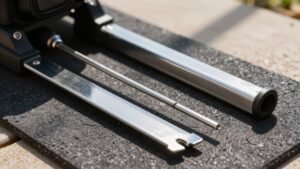
Oregon Replacement Deck Leveling Gauge

Convertible Design: The removable wheeled deck allows quick transformation into a small lawn mower for versatile yard care

Multi-Function Convenience: Easily switch between mowing, trimming, and edging for three-in-one versatility with your string trimmer
When to Mow: Frequency & Height Maintenance
After setting the correct mowing height for your grass species, you need to schedule cuts that match growth rates. In spring and early summer, mow once or twice a week, aiming for a 4‑7‑day interval for cool‑season grasses and a 3‑5‑day interval for warm‑season varieties. As temperatures rise and growth slows, extend to 7‑10 days. Fall resumes the spring cadence, while winter calls for dormant season mowing only when the turf is actively growing in mild climates. Never remove more than one‑third of blade height; this protects root integrity and reduces scalping risk. Maintain efficient blade rotation by clearing debris and adjusting speed for dry grass, ensuring uniform cuts and ideal lawn health. Lower mowing height requires more frequent cutting to stay within the one‑third rule. Understanding soil temperature helps predict when the grass will exit dormancy and resume active growth. During heatwaves, consider extending the interval to seven to ten days to avoid stressing the grass.
Mowing Patterns That Preserve Height Uniformity
A mower’s path shapes the lawn’s visual texture, so varying the direction each time you cut keeps the turf grain from locking in and prevents wheel‑track ruts. Alternate between horizontal, vertical, diagonal, and circular patterns each week. Switching direction reduces turf grain development, promotes upright shoots, and avoids soil compaction from repeated wheel lines. Use a small central circle, expand outward with consistent spacing, and keep grass at 3‑3.5 inches for ideal visibility enhancement on cool‑season varieties. Overlap each pass slightly, and change from straight to diagonal runs to break pattern repetition. Maintain a high blade setting during striping to preserve height uniformity and prevent patchiness. These systematic variations guarantee even cutting, healthy growth, and a consistently smooth lawn. Mow new lawns more often in the first few weeks to encourage dense root systems and optimal mowing frequency. Understanding growth cycles helps schedule mowing to match peak grass development.
Blade Maintenance for Consistent Mowing Height
Every 20–25 hours of mowing, inspect the blade for ragged cuts or brown tips; dull edges tear grass, promote disease, and compromise height uniformity, while a sharp blade delivers clean cuts that preserve the set mowing height. Follow a strict blade maintenance routine: remove sticks and rocks before each pass, wipe off clippings, and run a lapping compound in reverse to hone the edge. If frayed tips appear, backlap with a professional kit or replace the blade. Pair cleaning with mower adjustment tips—verify the cutting height, set the reel drum for even pressure, and calibrate the height based on lawn response rather than gauge numbers alone. Sharpen at least once per season and check every 20–25 hours to keep cuts precise and height consistent. For optimal performance, consider the blade material when planning your sharpening schedule. Regularly inspect the blade’s edge angle to ensure it matches the manufacturer’s specifications for optimal cutting efficiency. A sharp blade also reduces weed seed spread by preventing torn grass that can harbor seeds.

Brushless Motor for Powerful Performance: SporGain mower blade sharpener tool is equipped with a high-performance brushless motor, this lawn mower blade sharpener provides stronger power, lower noise, and longer lifespan than traditional motors, delivering smooth and efficient sharpening for lawn mower blades
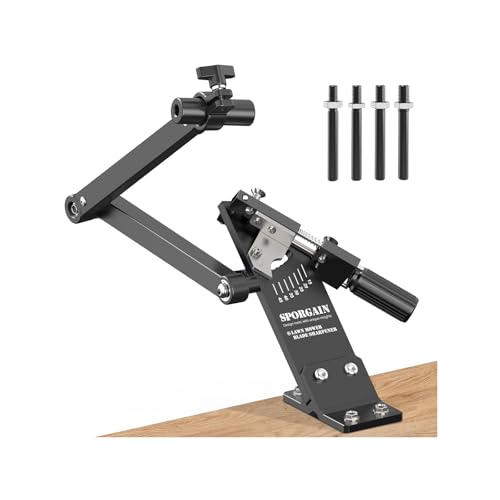
[ Updated ] Lawn Mower Blade Sharpener: SporGain mower blades sharpener suitable for Blades standard straight, mulching and high-lift mower.
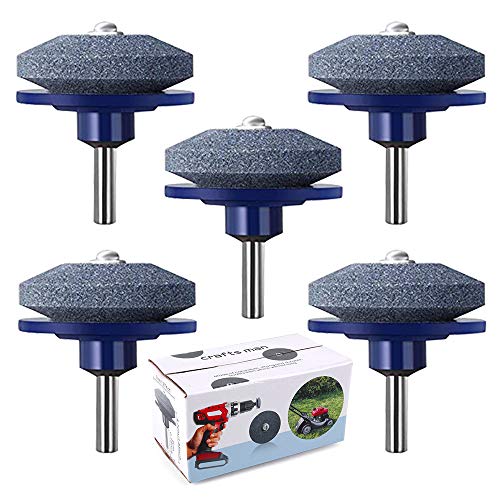
Lawn Mower Blade Sharpener : The new version of the Lawn Mower Blade Sharpener is Made of corundum, it solves the base wear caused by the excessive speed of grindstone, and effectively prolongs the service life and improves the use effect of the product. Our lawn mower blade sharpener is provided by the original factory, and it is guaranteed.
Clipping Management to Preserve Soil Height & Nutrition
How can you keep your lawn healthy while maintaining soil height and nutrition? You should leave clippings on the surface, letting them decompose into a fine mulch that conserves moisture and releases nitrogen slowly. Apply the one‑third rule: never cut more than 33 % of blade length, which preserves root depth and reduces stress. Use a mulching mower to produce uniform particles; then conduct mulch quality monitoring to verify particle size and decomposition rate. When clippings accumulate excessively, practice sustainable clipping disposal by composting or spreading thin layers to avoid smothering. Direct clippings away from waterways and paved areas. This approach maintains soil shading, supports deeper roots, and supplies a steady nutrient feed without additional fertilizer. Mulching leaves also improves soil health by returning organic matter and beneficial microbes to the lawn. Follow the seasonal fertilization schedule to complement the nutrients provided by mulching. Watering after mowing enhances recovery by reducing stress and promoting deeper root growth.
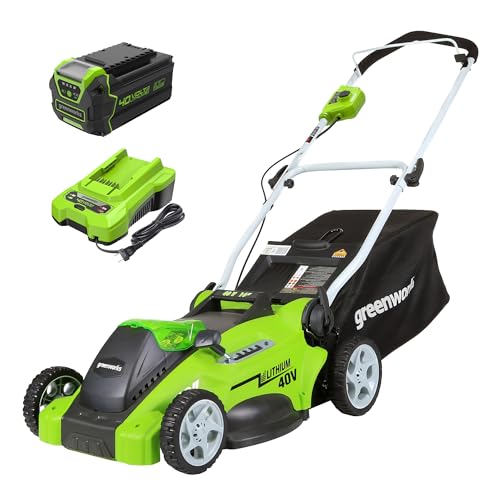
[16" LAWN MOWER] - This 40V lawn mower cuts up to 1/3 acre with fully charged 4.0Ah battery (varies based on grass condition and operator technique)

Powerful Engine: Equipped with a high-performance 144cc 4-stroke OHV engine and an auto-choke for easy starting, this mower delivers reliable power and fuel efficiency.

Efficient & Versatile Mowing Solution This 21-inch self-propelled lawn mower features a durable 3-in-1 steel deck with mulching, side discharge, and rear bagging options. The wide cutting path maximizes efficiency, while the no-choke, no-primer design ensures hassle-free starting—no manual adjustments needed.
Seasonal Mowing Height Adjustments for Heat & Cool‑Season Grass
When temperatures rise, adjusting mowing height becomes essential for both cool‑season and warm‑season grasses. In summer, raise cool‑season cuts 0.5 inch above normal—Kentucky Bluegrass 3‑3.5 in, Tall Fescue 3‑4 in, Perennial Ryegrass up to 4 in—to deepen roots and shade soil. Warm‑season species stay low: Bermuda 1‑2.5 in, St. Augustine 2.5‑4 in, Zoysia 1‑3 in, Centipede 2‑2.5 in, keeping canopy dense and moisture retained. Follow the one‑third rule; never remove more than a third of blade length. For spring recovery, lift cool‑season grass to 3 in+ and cut warm‑season to 0.5‑1.5 in, clearing dormant strands. In fall, shorten cool‑season to 2.5 in and warm‑season to 1.5‑2 in, preparing for dormant season heights. When overseeding, maintain higher midsummer cuts to protect seedlings and reduce competition. Avoid mowing during extreme heat to prevent stress and dehydration of the turf. Proper soil testing helps determine the ideal fertilization schedule to support healthy growth throughout the year. Schedule mowing in the early morning or late evening when temperatures are below 90 °F to minimize heat‑induced stress.

Efficient & Versatile Mowing - Our 21-inch lawn mower features 3-in-1 steel deck with mulching, side discharge and rear bagging and provides an extensive mowing path for efficiency. No choke, no primer design make it easy to start.

Easy Start Engine: The144cc 4-stroke OHV engine delivers a reliable balance of high performance and ease. Equipped with auto choke for easy start, and primer structure for better starting.

Keep Your Lawn Spotless: Unlike most lawn sweepers, our lawn sweeper has thickened and densified brushes to increase the overall sweeping force and prevent deformation. With a sweeping width of 21"/53.5 cm, it can pick up 80% of the debris in one pass.
Mowing in Shade and on Slopes: Height & Safety Tips
If you’re mowing a shaded lawn or a sloping area, set the deck higher than you would on flat, sun‑exposed turf—typically 3–5 inches for shade‑tolerant grasses and the upper end of the recommended range (2–4 inches, up to 3.5 inches) for slopes—to safeguard roots, retain moisture, and prevent scalping. Use sharp blades to avoid tearing, and never remove more than one‑third of the blade in one pass. Mow across slopes horizontally, never up and down, to maintain traction and power mower safety. Keep the deck clean and check blade condition frequently; dull blades cause browning. Schedule weekly mowing, avoid wet grass, and rotate direction to reduce compaction. Perform regular trimmer maintenance to guarantee consistent edge quality on uneven terrain. Sharp blades produce a cleaner cut and reduce stress on the grass, leading to a healthier lawn and optimal blade sharpness. A sharp edge also promotes faster grass recovery after cutting.

Compatibility: Compatible with Raptor SD, Raptor SDX 36-inch, 48-inch, 54-inch, and 60-inch zero-turn mowers.

Replaces Part Number / Alternative model: 589464807, 532195179, 581897001, 589464803, 532195174, 532195181, 532195171Compatible With Husqvarna, AYP, Craftsman and Other Brand Lawn Mower Models..

[Fitment]: Adjustable Foot Pedal Compatible with Bad Boy Mowers Maverick, ZT Elite, Avenger, and MZ Magnum models. Designed to improve comfort and ease of operation when adjusting the deck height on mower
Common Mowing Mistakes & Quick Fixes for Height Accuracy
Because uneven cutting height quickly leads to scalping, weed invasion, and disease, you must verify and adjust your mower’s deck before each session, check tire pressure, and measure the actual blade clearance on a level surface to guarantee you’re consistently removing no more than one‑third of the grass blade. Use calibration tools to set the deck, then run height verification checks on a driveway to confirm true clearance. Dull blades tear grass, so sharpen every ten mowing hours or swap a backup blade. Inaccurate notches often mislead; measure directly rather than trusting settings. Adjust tire inflation to keep the deck level, and raise the cut by an inch during peak summer heat. Regularly repeat these steps to maintain precise height across seasons. Cutting grass below 2 inches requires a reel mower, which is expensive and needs frequent maintenance. Following proper safety and gloves can stepping the brass of the sharpening process. Leveling the deck ensures consistent blade clearance and optimal cutting performance.