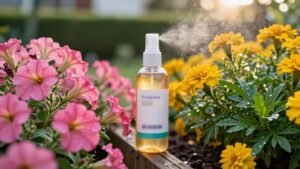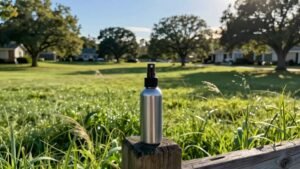

Selective herbicides spare your grass because they target biochemical pathways and enzyme structures that exist only in broadleaf dicots, not in monocot grasses. If you mix or apply the product incorrectly—using the wrong ratio, uncalibrated sprayer, or treating at high temperature or wind—grass can burn or become vulnerable to disease. Spot‑treat weeds instead of broadcasting, and apply between 7 AM–10 AM when temps are 65‑85 °F, wind under 3 mph, and no rain is forecast. Proper timing, dosage, and technique keep your lawn healthy, and the next sections reveal more detailed safeguards.
Explain Why Selective Herbicides Spare Grass
Because selective herbicides are formulated to target biochemical pathways unique to broadleaf dicots, they leave grasses untouched when applied correctly. You benefit from grass metabolic differences that prevent the active ingredient from binding to monocot enzymes; the pathways inhibited in dicots—such as aromatic amino‑acid synthesis—are either absent or structurally distinct in grasses. Selective absorption mechanisms further protect your lawn: grasses uptake the compound at lower rates, and their cuticle and root exodermis restrict translocation to meristematic tissue. Consequently, the herbicide accumulates in broadleaf foliage, disrupting cell division and causing necrosis, while grass cells metabolize or sequester the molecule without damage. Proper timing and dosage preserve turf integrity, ensuring only target weeds are eliminated. This effect is enhanced when the herbicide is a soil‑active pre‑emergent that remains in the root zone, targeting germinating weed seedlings without affecting established grass roots. Understanding the distinction between systemic and contact herbicides helps you choose the right product for your lawn care strategy. Applying herbicide at the recommended growth stage maximizes selectivity and minimizes collateral damage.
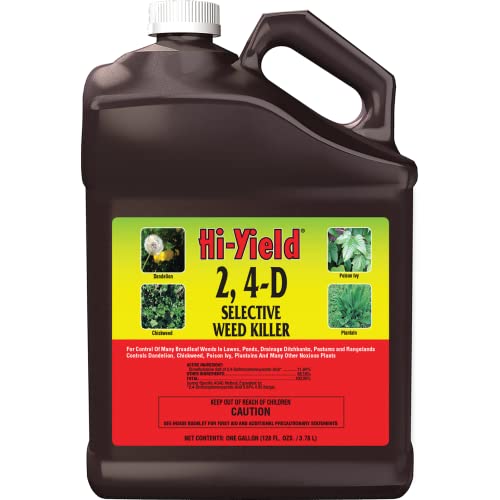
This selective weed killer kills or controls many Broadleaf Weeds and plants susceptible to 2, 4-D.
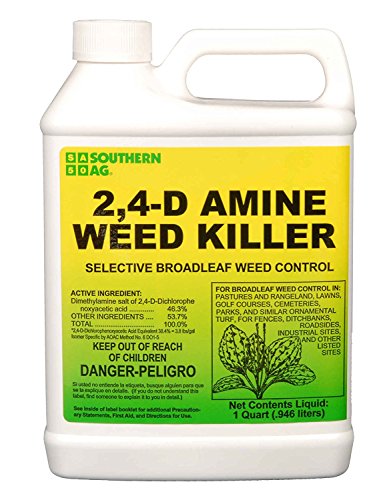
Low, economical use rate of 1 to 4 pints per acre

Fast Acting Broadleaf Weed Control
Selective Herbicide Mistakes That Kill Grass
While selective herbicides protect turf when used correctly, common mistakes can quickly turn them into grass killers. Incorrect mixing ratios cause either under‑dilution, which fails to control weeds, or over‑concentration, which burns grass roots. Improper application techniques—such as using an uncalibrated sprayer, broadcasting instead of spot‑treating, or spraying too fast—create uneven coverage and drift onto healthy turf. Misidentifying weeds leads you to apply a broadleaf formula on grassy weeds, delivering an active ingredient that the grass cannot tolerate. Over‑application weakens root systems, increasing susceptibility to disease and future weed pressure. Even on stressed lawns, excess chemical load compounds heat or drought stress, resulting in visible die‑back and reduced recovery. Follow label rates, calibrate equipment, and match the product to the target weed to avoid these pitfalls. Understanding the active ingredient differences between herbicides helps prevent unintended turf damage. The mode of action of a systemic herbicide determines how quickly it translocates and kills the plant. Using low‑toxicity formulations can further reduce the risk of collateral damage to the lawn.

KILLS WEEDS – NOT THE LAWN: When used as directed

LAWN FRIENDLY FORMULA: Our lawn friendly weed killer spray formula contains three proven ingredients that specifically target common lawn weeds, so it won't harm your grass (when used as directed)

WEED KILLER FOR LAWNS: Ortho WeedClear Lawn Weed Killer Concentrate weed killer spray kills crabgrass, dandelions, clover, and other listed common weeds in your lawn
Weather‑Wise Timing for Selective Herbicide Application
When you align herbicide sprays with ideal weather windows, you maximize uptake and minimize turf stress. Target the 7 AM‑10 AM slot in spring or early fall when temperatures sit between 65°F and 85°F, dew has dried, and wind stays under 3 mph. Guarantee proper product dilution to achieve optimal spray coverage without runoff. Avoid applications above 85°F, during high wind, or when rain is forecast within 24 hours, as moisture washes off the product and heat accelerates evaporation. Use the 4 PM‑7 PM backup only if temperatures remain below 85°F and humidity is low. In winter, postpone treatment because dormant weeds won’t absorb the herbicide. Follow these data‑driven timing rules to protect grass while controlling weeds. Applying herbicide to damp foliage can dilute efficacy and increase runoff risk. Proper storage extends shelf life, and checking the expiration date before use helps ensure effectiveness. Storing fertilizer in a cool, dry place can significantly prolong its nutrient potency.

Kill chickweed, clover, dandelions, ground ivy and other tough weeds with Chickweed Clover & Oxalis Killer Concentrate from Bonide
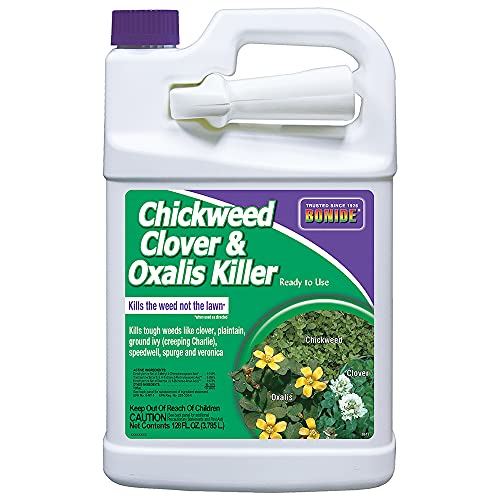
Kill chickweed, clover, dandelions, ground ivy and other tough weeds with Chickweed Clover & Oxalis Killer Ready-to-Use Spray from Bonide

KILLS WEEDS AND GRASSES: Use on driveways and walkways, and around fences, trees, flower beds, shrubs and other listed areas
Choose Spot‑Treat or Broadcast Application
Spot‑treating lets you target individual weeds with a handheld sprayer or brush, keeping herbicide use and turf stress to a minimum, while broadcast application coats the entire lawn uniformly, delivering quick coverage for dense infestations. When you choose spot‑treat, you achieve a targeted application impact: the herbicide contacts only the weed canopy, preserving surrounding grass and reducing chemical volume. Use a pump sprayer or brush, follow the product’s chemical‑to‑water ratio, and remain within the 10,000 sq ft label limit. For large lawns with high weed density, broadcast spraying offers full coverage efficiency—spraying gallons per acre guarantees uniform distribution and faster treatment. Adjust mixture rates as needed, but keep the same active ingredient concentration for both methods to maintain efficacy. Incorporating mulch barriers can further suppress weed emergence between applications. Acetic acid in vinegar can damage leaf tissue but does not reliably reach the root zone. Adding higher acetic concentration can improve control of tougher perennial weeds.

Designed for homeowners and professionals: reduce mess and speed up lawn care with a wide‑mouth, translucent 48‑ounce tank that makes refilling and fluid‑level checks simple. The seals and gaskets work with all common lawn and garden, weeds and pest chemicals

PetraTools Garden Sprayer - Perfect for DIYers Seeking Professional Results: Our durable yet lightweight water sprayer, with a 52” hose and 16” wand, ensures comfortable extended use and excellent coverage, making it ideal for versatile liquids such as fertilizers, mulch glue, and pesticides.

Versatile Sprayer for Every Need - This simple and easy to use pump sprayer is perfect for DIYers and Homeowners looking for professional results. Great for lawn and garden solutions, weed killer sprayer, mulch dye, fertilizers, grass paint, water sprayer and more!
Pre‑Emergent Barriers: Effects on New Seed
Unlike spot‑treating, which limits herbicide exposure, pre‑emergent barriers act throughout the soil profile, creating a chemical shield that halts root development for both weeds and newly sown grass. You’ll find that the barrier’s active compounds persist for months, so any seed placed after application experiences immediate inhibition of root growth effects and delayed seed germination timing. Federal label guidance mandates waiting until seedlings have at least 2 inches of root development before applying Barricade, and delaying overseeding by four months after the lightest dose. If you must seed sooner, rake and turn the soil to break up the barrier, then wait 7–10 days before sowing. Choosing a seeding‑compatible pre‑emergent prevents total germination failure and preserves seed investment. Scott’s Halts Crabgrass and Grassy Weed Preventer is not suitable for use when seeding a lawn. Applying a post‑emergent weed‑and‑feed after the new grass is established—generally 4‑6 weeks—helps avoid the germination‑inhibiting effects of pre‑emergent products. Proper timing ensures the herbicide does not interfere with the lawn’s natural growth cycle, especially during the critical early root development phase. Understanding soil moisture levels is essential for maximizing pre‑emergent efficacy.
Apply Fast Recovery Techniques
If you act quickly after a herbicide incident, you can minimize damage and restore a healthy lawn within weeks. Begin with heavy watering to dilute residual chemicals, then remove dead turf using a pick‑hoe. Apply Seasol 25 L top‑dress mix, level the soil, and rake lightly to embed seed to the top ¼ inch. Use a roller to improve seed‑to‑soil contact, then water lightly 2–3 times daily until the soil stays moist at a 2‑inch depth. Shift to deeper, less frequent watering once seedlings reach 3–4 inches. Conduct post‑application monitoring of soil moisture and herbicide breakdown to gauge environmental impact. Power‑rake any uneven patches, fertilize, and maintain dense mowing to crowd out weeds and accelerate recovery. Power raking can help remove excess thatch that contributed to the brown patches. Proper timing of dethatching maximizes air‑water‑nutrient penetration and reduces stress on the recovering grass. Regularly aerating the lawn creates soil channels that enhance root growth and improve water infiltration. Dethatching promotes healthier soil structure and reduces disease risk.
Identify Herbicide Burn vs. Insects or Disease?
How can you tell whether a brown, wilted patch is herbicide burn or a pest‑ or disease‑induced problem? Look first at timing and pattern. Herbicide burn appears within 3–7 days, forms irregular patches that match low‑moisture zones, and often shows a bleached or yellow‑red hue from actives like mesotrione. In contrast, disease creates uniform leathery textures and distinct concentric patterns, while insects cause irregular bite marks and leaf thinning. Check environmental data: temperatures above 85 °F, low humidity, and sand pockets raise phytotoxic risk, especially when spray volume is low or drift occurs. Use weed species identification and turfgrass tolerance levels to gauge susceptibility; tolerant species may show only mild wilting, whereas sensitive varieties exhibit rapid desiccation and twisted stems. Finally, conduct a moisture‑linked patch test to confirm herbicide involvement. Soil microbial activity can significantly accelerate the breakdown of many herbicides, reducing the duration of visible damage. Boiling water can be applied as a spot treatment to kill individual weeds without harming surrounding grass when used carefully.