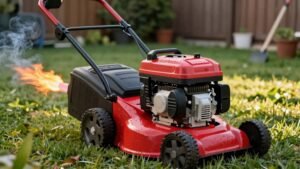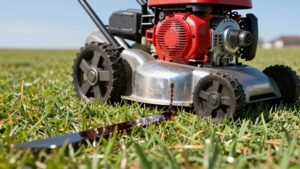

Your lawn‑mower battery will typically last 8‑12 years if you choose a LiFePO₄ cell and keep it between 20‑80 % charge, while lead‑acid or AGM units usually need replacement after 3‑5 years of regular use. Cold snaps, excessive heat, thick wet grass, and vibration all accelerate wear, as do neglecting maintenance and deep discharges. To extend life, charge after each use, store indoors at moderate charge, clean terminals, and avoid extreme temperatures. More details on selecting the right battery and maintenance tips follow.
Which Lawn‑Mower Battery Type Lasts the Longest?
When you compare mower battery chemistries, the LiFePO₄ cell clearly outlasts the rest, delivering 8‑12 + years of service and exceeding 2,000 charge cycles. You’ll find its high‑temperature stability, low self‑discharge, and robust safety profile make it the premier choice for long‑term use. Storage considerations require keeping the pack at 40‑60 % state‑of‑charge in a cool, dry environment; this minimizes capacity loss between seasons. Replacement guidelines suggest inspecting voltage and internal resistance after 1,500 cycles; swap the unit before voltage drops below 3.0 V per cell to avoid sudden failure. In contrast, lead‑acid and NiCd units demand frequent electrolyte checks and full‑discharge cycles, while lithium‑ion offers moderate longevity but still falls short of LiFePO₄’s extended service life. Properly balancing cells during charging can further extend the lifespan of the battery. Maintaining optimal storage temperature is essential to prevent accelerated degradation.

ML-U1-CCAHR is a 12V 320 Cold Cranking Amps (CCA) Sealed Lead Acid (SLA) Battery.

√ Dimensions: Length 7.68 inches, Width 5.12 inches, Height 6.3 inches, Total Height 7.1 inches; Weight: 5.09 lbs, Battery Terminals Type: Square Hole Nut and Bolt, NB, Nut and Bolt, J; The positive terminal is on the left side of the battery; Cold Cranking Amps: 480CCA; Terminal: Left : Positive (+)-Red, Right: Negative (-)-Black.
What Conditions Shorten a Lawn‑Mower Battery’s Life?
LiFePO₄ batteries outshine other chemistries, but they’re still vulnerable to several everyday factors that can erode their lifespan. Cold snaps drop voltage quickly, shortening mowing time, while heat accelerates electrolyte breakdown and can cause premature failure. Avoid charging in freezing weather; let the pack reach room temperature first, and store it in a temperature‑controlled space. Thick, wet, or tall grass forces the motor to draw more current, and rough terrain adds vibration that degrades internal components. Skipping battery maintenance—letting the pack sit empty, overcharging, or leaving it on a charger for days—hastens capacity loss. Dull blades, clogged decks, and corroded terminals increase resistance, forcing the battery to work harder and shortening its useful life. Adjust your mowing schedule and perform regular battery maintenance to mitigate these risks. Regularly checking the state of charge helps identify early signs of degradation. Proper deck cleaning prevents clinging grass from increasing load on the battery. Regularly lubricating moving parts reduces friction and helps maintain consistent power draw.
How Can You Extend Your Lawn‑Mower Battery’s Life?
You can substantially boost a lawn‑mower battery’s lifespan by following a disciplined charging routine, storing it correctly, maintaining terminals, and optimizing mowing practices. Charge after each use, even if the pack isn’t fully depleted, and keep the charger in moderate temperature ranges. Use the OEM charger, and for lithium‑ion cells stay between 20 % and 80 % charge, avoiding full‑charge spikes and immediate recharging after short runs. Unplug when full or rely on a smart charger with auto‑shutoff; never let the voltage drop below 20 %. Apply proper storage techniques: keep the battery indoors at a warm ambient temperature, maintain a 30‑60 % charge level, and top up every one to two months on low amperage. Follow routine maintenance procedures by inspecting terminals for corrosion, cleaning with a baking‑soda solution, applying terminal grease, and keeping the blade sharp and cutting deck clear to reduce motor load. Store the battery in a warm, indoor location during off‑season to prevent premature discharge. Higher voltage models typically deliver more power and longer runtimes, aligning with the mower’s motor design and usage demands. Check oil level before each session to ensure the engine runs efficiently and does not strain the battery.

Charger, Maintainer & Desulfator - An all-weather battery charger, battery maintainer, trickle charger, and battery desulfator. Perfect for charging and maintaining all 12-volt lead-acid, flooded or sealed maintenance free batteries (AGM and gel cell).

【THE PERFECT WINTER BATTERY CHARGING SOLUTION】Corebox automatic battery trickle charger with 8 charging protections is an all-in-one solution: charger, maintainer, trickle charger and desulfator. It ensures perfect maintenance of battery charging safety during the winter or vacation months, avoiding battery failure in advance. Temp compensation in hot or cold climates, reverse protection, cooling system, overcurrent, fireproof material, overcharge, short circuit.
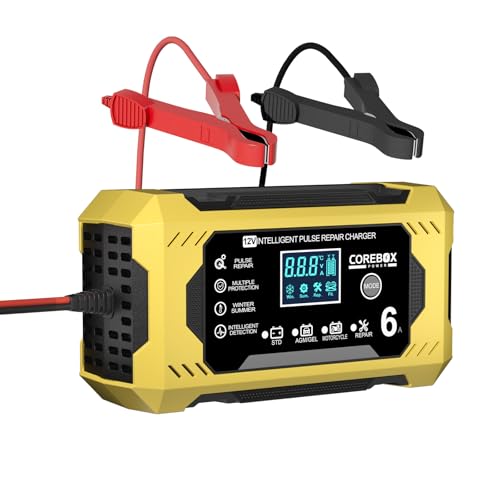
【THE PERFECT WINTER BATTERY CHARGING SOLUTION】Corebox automatic battery trickle charger with 8 charging protections is an all-in-one solution: charger, maintainer, trickle charger and desulfator. It ensures perfect maintenance of battery charging safety during the winter or vacation months, avoiding battery failure in advance. Temp compensation in hot or cold climates, reverse protection, cooling system, overcurrent, fireproof material, overcharge, short circuit.
What Warning Signs Show a Battery Needs Replacing?
Even with diligent charging and storage, a lawn‑mower battery will eventually show unmistakable signs that it’s time for a replacement. You’ll notice no start or clicks when you turn the key; the motor may emit a faint click, indicating insufficient power delivery. A slow crank, rapid loss of runtime, or a mower that dies after 10‑15 minutes signals reduced recharge capacity. Charging failures appear when the charger shows a full‑charge light but the mower still won’t run, or when an error persists after an eight‑hour charge. Low voltage readings—below 12.6 V for lead‑acid or 14 V for lithium‑ion—confirm the issue. Physical clues include corrosion on terminals, cracked casings, bulging sides, or fluid leaks. Overheating symptoms, such as excessive heat during operation, further point to a failing battery that needs replacement. A weak or dead battery can also cause the mower to crank without starting, especially if the spark plug is fouled and not igniting the fuel mixture. A clogged fuel filter can prevent proper fuel flow, exacerbating the symptoms of a dying battery. Stale fuel can also cause the mower to struggle, since old gasoline may not ignite properly even with a healthy battery.

Starter kit includes (2) 4.0Ah USB batteries and dual port rapid charger to power any Greenworks 24V or 48V (2 x 24V) product

【Durable 304 Stainless Steel Construction】Crafted from premium 304 stainless steel battery bolts and nuts, this hardware offers exceptional strength and longevity. It provides superior resistance to rust, corrosion, and oxidation compared to standard battery terminal bolts and nuts carbon steel, ensuring reliable performance in demanding environments like motorcycle battery compartments and outdoor applications. This material choice guarantees enduring connections without degradation over time, even with exposure to battery acids and weather elements.

Replacement for Ryobi 40V Battery and Charger Combo: Battery Type: Lithium-ion | Voltage: 40V | Capacity: 6500mAh | Charger Iuput: 100-240V/50-60Hz Output: 40V 6A/2*3.0A. A combo to fulfill your work needs at once.
Which Battery Should You Pick for Your Mower?
Choosing the right mower battery hinges on balancing power demand, maintenance tolerance, and operating environment. If you prioritize low cost and proven reliability, a standard 12‑V lead‑acid U1 battery fits most riding and zero‑turn mowers, but you’ll need regular water‑level checks and monitor CCA (200‑230) and Ah (35‑40) for battery charge optimization. For heavier duty or cold‑weather work, consider a U1‑3 variant: identical size, higher CCA (340‑425) and better cold‑cranking performance, yet still requires water maintenance. AGM batteries eliminate water checks, offering spill‑proof, maintenance‑free operation and stable output in low temperatures. Lithium‑ion or LiFePO4 cells deliver rapid recharge, higher charge efficiency (99 %), extended runtime, and superior thermal stability, reducing battery maintenance considerations dramatically. Choose the chemistry that matches your mower’s power profile and your willingness to perform routine upkeep. For high‑traffic lawns where durability is critical, Toro’s powerful engines often pair well with high‑capacity lithium batteries. Brushless motors provide higher torque and quieter operation, making them an ideal match for efficient battery systems. The longer runtime of LiFePO4 can be especially beneficial for larger yards.