

If your grass is growing slower than normal, turning pale or yellow, or developing thin, patchy spots, those are clear signs it lacks essential nutrients and needs fertilizer. Yellowing of older blades or a mosaic of light‑and‑dark green patches points to nitrogen deficiency, while thin, uneven turf often signals poor soil preparation or compaction. Under‑fertilized lawns invite weeds and pests and struggle to recover after rain. Adjusting nitrogen‑only versus balanced NPK rates and timing applications to soil temperature can restore vigor, and the next sections will show you exactly how.
Slow Lawn Growth? When Fertilizer Is Needed
A few key signs can tell you whether your lawn truly needs fertilizer. You’ll notice growth rates below the normal range for your grass type, thin turf density, and shorter blades that never reach the typical height. Patchy expansion in new or recovering sections signals that nutrient supply is lagging. Analyzing soil moisture patterns helps you confirm that water isn’t the limiting factor; consistent moisture at 55‑65 °F for cool‑season or 65‑75 °F for warm‑season grasses indicates the soil is ready for nutrient uptake. Apply a slow‑release formula to stimulate biological activity, delivering nitrogen steadily over 8‑12 weeks. This approach avoids rapid spurts, supports root development, and maintains even growth without leaching. Applying TX helps slow vertical growth, reducing mowing frequency during decorative periods. Proper fertilizer also enhances soil health by balancing nutrient levels and fostering beneficial microbial activity.

Feel Proud of Your Lawn: Slow release fertilizer packed with 65% granular nitrogen - this spring lawn fertilizer feeds up to 110 days for deep green grass and lush growth you’ll love coming home to

FALL LAWN FERTILIZER: Scotts Turf Builder WinterGuard Fall Lawn Food is a fertilizer that builds strong, deep grass roots for a better lawn next spring

Feel Proud of Your Lawn: Slow release fertilizer packed with 65% granular nitrogen - this spring lawn fertilizer feeds up to 110 days for deep green grass and lush growth you’ll love coming home to
Spotting Yellow or Pale Grass – The Nitrogen Deficiency Signal
When growth slows, the next clue is color: pale green or yellow patches signal nitrogen deficiency. You’ll notice a pale yellowing pattern that spreads unevenly across the lawn, with older lower leaves turning straw‑colored while newer shoots stay darker green. This mobile nutrient deficit shows up as light‑green swatches, often interspersed with richer tones. Examine underlying soil conditions; low nitrogen levels reduce chlorophyll synthesis, causing chlorosis and faded hues. The symptom appears first on mature tissue, then gradually expands, creating a mosaic of pale and dark areas. Expect slower growth, increased weed intrusion, and occasional wilting in these zones. Recognizing this precise visual cue lets you target nitrogen replenishment before the turf deteriorates further. Understanding the timing of seasonal fertilizer applications can prevent nitrogen deficiency and keep your lawn healthy year‑round. Applying fertilizer when soil temperatures exceed 85°F can cause nutrient burn and stress to the grass. Proper timing of fertilization in the spring season maximizes nutrient uptake and promotes vigorous growth.
Identifying Thin, Patchy Spots That Need a Nutrient Boost
If you notice thin, patchy spots spreading across your lawn, the underlying cause is often a nutrient shortfall that hampers root growth and leaf development. You should first examine color uniformity; yellowing or pallid blades indicate nitrogen or potassium deficiencies, while stunted growth points to phosphorus gaps. Conduct a soil test to quantify nutrient balance concerns and verify pH, then compare results to ideal turf ranges. Simultaneously assess soil density; compaction restricts root penetration, limiting nutrient uptake even when levels are adequate. Apply compaction remediation strategies such as core aeration or vertical slicing to restore porosity. After aeration, amend the soil with compost or a balanced fertilizer, targeting the identified deficiencies to promote dense, resilient turf. Regularly schedule core aeration to maintain soil health and enhance nutrient absorption. Proper timing of aeration in early spring or fall maximizes the benefits of soil aeration for lawn vitality.
How Under‑fertilization Invites Weeds & Pests
Why does a lawn that lacks fertilizer quickly become a playground for weeds and pests? When nitrogen and phosphorus dip, grass thins, reducing its ability to shade soil and suppress competing weed germination. The nutrient‑poor substrate shifts pH and weakens root development, creating bare patches where acid‑loving weeds thrive. Simultaneously, stressed turf emits chemical cues that attract grubs, chinch bugs, and sod webworms, triggering a pest population explosion. The weakened canopy offers shelter for aphids and mites, while microbial imbalance invites nematodes and fungal pathogens. As weeds establish, they provide additional refuge for insects, reinforcing a feedback loop that further erodes turf density. Restoring balanced nutrition restores competition and curtails both weed and pest incursions. Proper soil pH adjustment with lime applications can also improve nutrient availability and deter certain acid‑loving weeds. Choosing the right fertilizer type based on soil test results ensures nutrients are delivered efficiently and safely. Applying fertilizer at the correct growth stage maximizes uptake and reduces waste.

High Phosphorus, High Potassium Lawn Food: If your lawn is showing symptoms of a Phosphorus and Potassium deficiency or if you want to maintain lawn health then this is the correct fertilizer for you!

Complete NPK Lawn Food: 16-4-8 is the perfect blend of key macronutrients. This lawn liquid food turf fertilizer also contains Seaweed & Fish.

15-0-15 Lawn Fertilizer To Promote Greening, Growth And Turf Hardiness: The Power Of Nitrogen & Potassium Blended With Humic, Fish And Seaweed. Intensify Green And Growth While Providing Key Nutrients For Turf Hardiness.
Why Your Lawn Won’t Bounce Back After Rain or Watering
The same nutrient deficiencies that invite weeds also make a lawn vulnerable to water‑related setbacks; once the soil is oversaturated, roots can’t breathe, and the turf stalls its recovery. When rain saturates the profile, waterlogged soil compaction collapses air pockets, creating anoxic root suffocation. You’ll notice yellowing or wilting despite moisture, because aerobic respiration halts and nutrient uptake stops. Compacted layers persist after drying, so footprints remain and mowers tear turf. Leached nitrogen and potassium further weaken photosynthesis, delaying green‑up. To restore vigor, let the soil dry to a 4‑inch depth, then aerate to re‑introduce oxygen and relieve compaction. Avoid traffic until the surface firms, and monitor for fungal lesions that thrive in prolonged dampness. Aeration also improves water infiltration by breaking up compacted soil, allowing nutrients to reach deeper roots more efficiently. Proper spring aeration promotes root health and prepares the lawn for successful fertilization. Regularly checking for clogged hose fittings can prevent water pressure loss when irrigating.
Soil Testing 101: Confirm Which Nutrients Are Missing
When you collect a soil sample and send it to a lab, the analysis will quantify macronutrients—nitrogen, phosphorus, potassium—alongside secondary nutrients like sulfur, calcium, and magnesium, plus a suite of micronutrients and key physical parameters such as pH, buffer pH, organic matter, and cation exchange capacity. You’ll receive exact concentrations for P, K, Ca, Mg, S, and micronutrients (Cu, Fe, Mn, Zn, B, Cl, Ni, Mo). Compare those numbers to the ideal ranges: pH 5.5‑6.5 for most lawns, Ca > 300 ppm, Mg > 35 ppm, S > 15 ppm. If any value falls short, note the deficiency and calculate the amount of amendment needed to achieve balanced nutrient ratios. Use the data to design precision fertilizer applications, targeting only the lacking elements and avoiding over‑application. Applying a thin layer of peat moss ¼ to ½ inch can help retain moisture and protect seed during germination. Proper topsoil preparation enhances seed‑to‑soil contact and creates a stable seedbed for robust root development. Understanding your lawn’s soil texture can further refine seed selection and planting strategies.

Quick, at home results for Soil pH, Nitrogen, Phosphorous and Potash Innovative and inexpensive soil test kit features an easy-to-use capsule system and patented color comparators

KNOW BEFORE YOU GROW | Grow the healthiest, sustainable lawn and garden with the most accurate and easy to use professional soil test kit on the market

✅ 1Dial & 1 LCD Screen - Replace/install all 3 batteries each time. Put button to %RH/°F to - Turn On, and put to LIGHT to - Turn Off. Read the LCD results in 3-5 mins. (Not Water Moisture Meter, so, please don't test liquid)
Choosing Between Nitrogen‑Only and Balanced NPK Fertilizers
After reviewing your soil test results, you can now decide whether to apply a nitrogen‑only fertilizer or a balanced NPK blend. If phosphorus and potassium levels are adequate, aim for ideal nitrogen only ratios of 30‑50 % N, such as a 5‑1‑2 or 5‑1‑3 blend, to trigger rapid vegetative growth without excess P/K. When your lawn includes mixed species, or you anticipate flowering, select balanced NPK composition ratios like 10‑10‑10 or 15‑10‑10, which supply 10‑20 % N, 10‑25 % P, and 10‑25 % K for maintained health. Observe leaf color, stem vigor, and root development after each application; adjust the formula only if deficiencies appear, avoiding over‑application of any single nutrient. This precision facilitates optimal growth while minimizing environmental impact. Repeated use of balanced fertilizers can lead to phosphorus surplus in the soil. Understanding the role of soil microbiome can further guide your nutrient strategy. Proper timing of fertilizer application can also weed suppression by promoting a dense, competitive turf. Applying fertilizer at the recommended soil temperature enhances nutrient uptake and reduces leaching.

Feeds for deep greening in just 3 days

Super-fine particles provide even distribution, with twice the number of particles per square foot
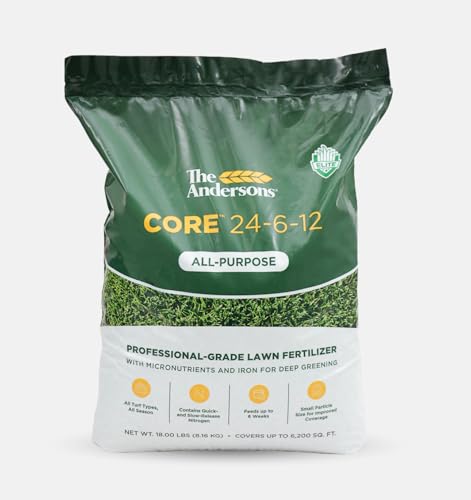
Formulated with the perfect 4:1:2 (24-6-12) ratio for high-performance results Includes iron and micronutrients for total nutrition. Super-fine particles provide even distribution, with twice the number of particles per square foot.
Best Timing for Fertilizer Application to Maximize Growth
If you target fertilizer applications to the periods when grass is actively growing, you’ll capture the highest nutrient uptake and drive maximal biomass. Schedule applications when the prime soil temperature reaches about 55 °F for cool‑season varieties and after dormancy breaks for warm‑season grasses. Early‑spring (March‑April) and Memorial Day (mid‑May) are primary windows; follow with a mid‑summer July 4th dose for cool‑season lawns and a Labor‑Day (early September) or early‑October overseeding application for warm‑season turf. Maintain a cycle of every 8‑10 weeks, allowing frequent reapplication throughout the growing season. Apply in the early morning or late afternoon, then water thoroughly to move nutrients to the root zone, ensuring best absorption and sustained growth. Milorganite is recommended for both new and established lawns to provide slow‑release nitrogen. Ensure the soil temperature is consistently above the 55 °F threshold before applying fertilizer to maximize uptake. Proper soil testing helps tailor nutrient blends to your lawn’s specific needs.
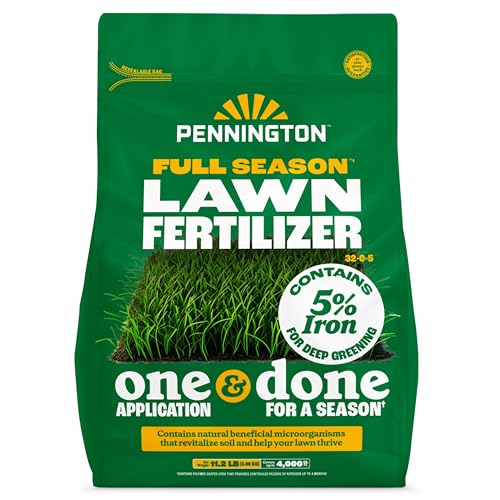
This spring lawn fertilizer is one application and done for a season

WHERE TO USE: Lawn fertilizer for grass can be used on any grass type
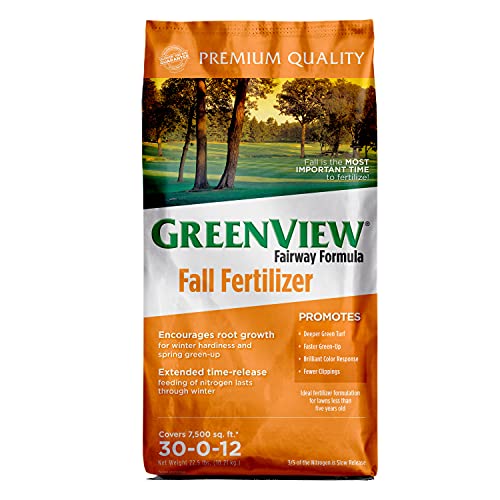
For Lawns: This grass fertilizer for lawns encourages deep root growth, brilliant lawn color, and thick lush growth
Adjusting Fertilizer Rates for Soil pH & Microbial Activity
Because nutrient uptake hinges on both pH and microbial vigor, you must tailor fertilizer rates to the soil’s chemistry and biological activity. First, measure current pH; if it falls below 6.0, apply agricultural limestone to raise pH to the 6.5‑7.0 range, noting the liming impact on pH for phosphorus and potassium availability. Next, conduct microbial activity monitoring: sample soil at 6‑8 °F, assess respiration, and adjust nitrogen applications accordingly, because low pH suppresses nitrogen cycling. If pH exceeds 7.5, reduce nitrogen and potassium rates, as excess alkalinity limits phosphate uptake. For acidic lawns, incorporate sulfur at 1‑2 lb per 100 sq ft to lower pH, but only after confirming microbial activity will support sulfur oxidation. Align fertilizer timing with ideal microbial temperature (≥55 °F) and adequate moisture to maximize nutrient use efficiency.
Quick Checklist: Does Your Lawn Need Fertilizer Today?
When you notice grass growing less than an inch per week, yellow or brown patches, and a surge of weeds or thin spots, those symptoms collectively signal a likely nutrient deficiency that warrants immediate fertilization. Check growth rate against the healthy one‑inch‑per‑week benchmark; a slower pace indicates nitrogen shortfall. Scan for off‑color turf—yellowing or browning confirms a nutrient imbalance. Observe weed density; abundant white clover or rust suggests nitrogen need. Examine thinning zones; low density invites invasive weeds. Review recent soil test results for nitrogen, phosphorus, and potassium levels; most soils supply adequate phosphorus and potassium, so focus on nitrogen. Finally, time the application for early spring or active growth periods to restore lawn vigor. Apply 13 lbs per treatment to meet the recommended nitrogen rate.