
Clear debris, loosen the soil 3‑4 inches, test pH, then blend in 5 cm compost, topsoil, and starter fertilizer. Choose a seed mix that matches your climate—cool‑season, warm‑season, or intermediate—and consider sun exposure and drought resistance. Split the seed, calibrate a spreader, and apply it in a criss‑cross pattern, alternating north‑south and east‑west passes, hand‑tossing where needed for full coverage. Lightly rake to embed seed, then mist the area 2‑4 times daily for the first three weeks, keeping the top inch consistently damp. Continue for details on mowing and fertilizing.
Prep Your Soil: Clear Debris, Loosen, Add Compost
Before you sow, clear the area of all debris, then loosen the soil and incorporate compost to create a receptive seedbed. Rake away rocks, sticks, and thatch, then mow the existing turf low and dethatch thick layers to expose bare soil. Till or dig to a depth of 3‑4 inches, breaking compaction and scattering clods into pea‑size particles. Conduct soil testing to determine pH and nutrient levels; if pH falls below 6.0, spread lime, and if it exceeds 7.0, apply sulfur or acidic compost. Mix 5 cm of compost, topsoil, and organic matter into the top 15 cm, adding gypsum for heavy clay if needed. Finally, work a starter fertilizer into the amended soil, ensuring even distribution for rapid germination and root development. Mechanical methods can be used to quickly turn hard soil into a fine, powdery texture, which is especially helpful for large areas. Tilling also helps to disrupt weed seed banks by exposing them to sunlight and predators. Using a lawn roller after seeding can improve seed‑soil contact and help flatten the surface for uniform germination. Applying fertilizer before seeding can reduce nutrient leaching and give the seed a richer environment for early growth.
After Preparing Soil, Pick the Right Grass Seed for Your Lawn’s Climate
Now that the soil is cleared, loosened, and enriched, you need to match your seed to the climate zone. Identify whether your lawn sits in a cool‑season, warm‑season, or intermediate zone. For northern, frost‑prone areas, select Kentucky bluegrass, fine fescue, perennial ryegrass, or tall fescue; these meet sun exposure requirements of 4–6 hours and provide drought resistant options when mixed with tall fescue. In southern, hot‑humid regions, choose Bermudagrass, Zoysia, or St. Augustine; they demand full sun (8+ hours) and excel in drought tolerance. Intermediate zones benefit from heat‑resistant tall fescues or Texas‑Kentucky bluegrass hybrids. Match shade‑heavy spots with fine fescue blends, ensuring each species satisfies both sun exposure requirements and drought resistant options for ideal establishment. Consider using Pennington Smart Seed mixes that are tailored to each zone’s specific climate conditions. Understanding soil pH helps fine‑tune nutrient availability for optimal seed germination. Selecting the proper seed blend maximizes germination rates across varying microclimates. Seed blend comparisons reveal that Scotts offers a broader range of disease‑resistant varieties.
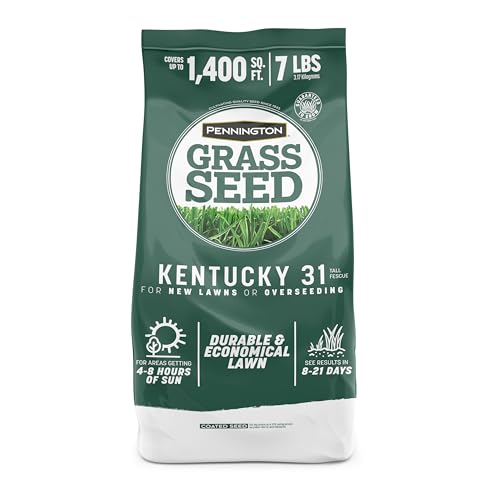
A grass seed for lawns that grows thick blades of grass that stand up to hot summers and heavy rains
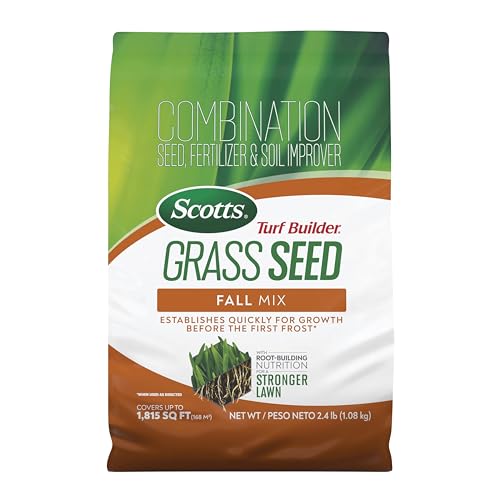
WHERE TO USE: This grass seed mix contains Kentucky bluegrass seed, perennial ryegrass seed, and creeping red fescue; it is designed for full sun and light shade, and has low drought resistance with medium durability

QUICKLY GROWS TURF - This rapidly establishing grass seed mixture grows quick-turf for problem areas. It's designed to fill in troubled areas in lawns or grow an entirely new lawn quickly. It germinates in 7 -10 days.
Spread Lawn Seed Evenly With a Criss‑Cross Pattern
If you split the seed into two equal halves and sow the first half in one direction—say north‑to‑south—then follow with the second half perpendicular (east‑to‑west), you’ll achieve a criss‑cross pattern that guarantees uniform coverage and eliminates clumps. Calibrate your spreader to the seed’s recommended consistent application rate before you start. Begin with perimeter passes along the lawn edge, then make parallel north‑to‑south sweeps, overlapping each pass by a few inches. Switch the spreader setting for the second half and repeat east‑to‑west sweeps, maintaining the same rate. For targeted application areas such as flower beds or obstacles, hand‑toss seed in small sections, shaking it evenly while you walk. This method secures full coverage, prevents clumps, and matches the seed’s packaging rate for ideal germination. Use a light layer of peat moss to retain moisture after seeding. Proper soil preparation ensures the seed has a loose, nutrient‑rich medium to establish strong roots. Adjust the seeding rate based on lawn size to avoid over- or under‑seeding. Selecting the appropriate depth for each grass type, such as one‑half inch for fine‑leaf varieties, maximizes germination success.

OPERATION: Adjustable arm support on this seed, salt and fertilizer spreader helps provide maximum comfort

Precise Spreading, Beautiful Lawn: With an 8-inch wide spread and 18 adjustable settings, plus a disc pellet controller, this push spreader ensures precise coverage of seeds and fertilizer. Multi-directional adjustments guarantee even distribution with no missed spots.

20-Pound Capacity: Large hopper holds up to 20 pounds of seed, fertilizer, or ice melt—ideal for treating large areas quickly and efficiently.
Ensure Lawn Seed‑To‑Soil Contact With Light Raking
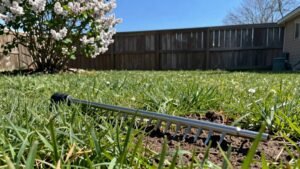
After laying the seed in a criss‑cross pattern, you must secure solid seed‑to‑soil contact, and a light rake does exactly that. First, mow the lawn low and, if thatch exceeds ½ inch, power‑rake to achieve turf thatch control. Then, using a broom rake or dethatching rake, make gentle, overlapping strokes no deeper than 1/8 inch. This light raking performs soil surface conditioning by breaking up crusted soil, dispersing dead material, and allowing tiny seeds to sift through thatch without burial. Keep the soil dry; avoid over‑raking, which can bruise living grass. The result is uniform seed placement, improved water and nutrient flow, and a healthier germination environment. Aggressive raking helps remove excess dead grass, ensuring better seed‑to‑soil contact. Regular dethatching also promotes deeper root growth by enhancing air and water penetration. Proper timing of dethatching maximizes air and water penetration and reduces disease risk.

Heavy duty 1" diameter expandable metal rake for leaves painted black to prevent rusting and bending under heavy use.

LAWN AND LEAF RAKE FOR RAKING LARGE QUANTITIES OF LEAVES AND YARD WASTE: Purpose-built heavy duty lawn rake for leaves and grass, easily collecting leaves, grass clippings, twigs, small branches, thatching, and all other yard debris; curved head and angled teeth engage all tines simultaneously for efficient raking and immediate scooping to speed up outdoor rake tasks across any lawn or garden

SHADE TOLERANT GRASS SEED - Our grass seed mix has shade-tolerant grass seeds designed for areas where the penetration of sunlight is limited. Perfect for lawns with big trees, large shrubs, or areas shaded by houses or other permanent structures.
Water Your New Lawn Right After Seeding: Light, Frequent Sprays
Because fresh seed needs moisture to jump‑start germination, you should apply a light, frequent mist immediately after spreading it, keeping the top 1–1.5 inches of soil consistently damp without creating puddles. Use a mist or oscillating nozzle set to a gentle spray; aim for a watering depth of about 2 inches and a watering duration of 5–10 minutes per session. Water 2–4 times daily, preferably early morning and late afternoon, to maintain constant moisture. Avoid runoff by adjusting flow until no puddles form. If you cover the area with a thin straw mulch, the mulch will reduce evaporation, allowing the same watering duration to sustain the required moisture. Continue this schedule for the first three weeks, then shift to reduced frequency as seedlings establish. Adjust watering frequency based on temperature and soil type to prevent rot and ensure optimal germination. Proper watering depth is crucial for establishing a healthy root system, especially in sandy soils that drain quickly.

Package include: The package contains 210pcs red 360° misting sprinklers. Overall Length: Approx. 0.87",Outer Dia.: Approx. 0.19". Sufficient for your daily use and replacement. If you have any problems, please feel free to contact us.

7 ADJUSTABLE WATERING PATTERNS: Each carefully selected pattern has an unique purpose,and each spray pattern will meet all of your watering needs. To change patterns simply twist the nozzle.Turn the spray nozzle dial to choose appropriate pattern easily with a faucet on the handle.

Practical Economy Set: Includes 2 pack Amber Spray Bottles and Sprayers, 2 Plastic Caps, One Pen,One Plastic Funnels,4 Waterproof Stickers,4 Regular Stickers,One Plastic Dropper
When to Mow and Fertilize Your New Lawn for Healthy Growth
Keeping the soil consistently moist after seeding sets the stage for the next critical step: timing your first mow and fertilizer application. Wait 4‑8 weeks, or until the grass reaches 3‑4 inches, before the first cut. Use a lightweight mower, set the deck to trim no more than one‑third of the blade height, and cut only when the foliage is dry. Immediately after mowing, apply a starter fertilizer—this aligns with starter fertilizer timing and supplies nutrients for root development. Maintain ongoing mowing adjustments: keep the blade height slightly higher for the first few cuts, then return to the normal schedule once the lawn establishes. Avoid over‑fertilizing; a single, balanced application after the first mow promotes healthy growth without stress. Proper soil testing before seeding helps ensure optimal pH and nutrient levels for robust lawn development. Regularly check the deck for levelness to guarantee an even cut and prevent scalping. Mowing frequency should be adjusted based on seasonal growth rates and weather conditions to avoid cutting more than one‑third of the blade at a time.

FERTILIZER FOR NEW LAWNS: Scotts Turf Builder Starter Food for New Grass is a specially formulated starter fertilizer for grass seed that is designed to be used when planting new grass

GREAT FOR SEEDING & SODDING - Veri-Green Lawn Food for Seeding & Sodding is formulated to get new grass seedlings off to a great start. It helps your lawn grow strong roots and grow faster and thicker when seeding, overseeding, and laying sod.

Grows new grass 70% thicker, 35% quicker versus unfed grass