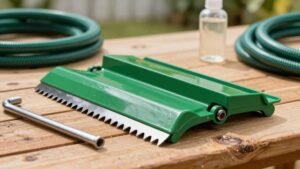

First, measure your home’s static pressure, subtract 20‑25 PSI to get dynamic pressure, then time a 5‑gallon bucket to find the supply GPM. Use a nozzle chart to pick a head type and note its GPM at that pressure. Add the GPM of all candidate heads, divide by your home’s GPM, and keep the ratio ≤1 to avoid over‑loading. Space heads at about 50 % of their throw for square layouts (or 60 % for triangular) and adjust spacing for slopes and sun‑exposed zones. Following these steps will let you fine‑tune the exact count for ideal coverage.
Calculate the Ideal Number of Sprinklers for a Zone
A typical residential system runs at 30‑50 PSI, so you first subtract 20‑25 PSI to estimate the dynamic pressure that actually reaches the heads. Use that dynamic pressure to consult the nozzle performance chart; it tells you the GPM each head requires at the calculated PSI. Add the GPM values for all candidate heads, then divide the sum by the total GPM your home supply can deliver. If the result exceeds 1, reduce head count or select lower‑flow nozzles to manage water usage and maximize head efficiency. Keep the zone within 5‑6 rotor heads or 8‑10 spray heads, avoiding overcrowding that causes clogs and dry patches. This schematic calculation guarantees each zone delivers uniform coverage without exceeding flow capacity. Measure static pressure at the hose bib to confirm the available water source meets the required PSI. Properly assess spray pattern to ensure even distribution across the lawn. Inspect the sprinkler heads for loose fittings that can cause rotation issues and correct them before testing the system. Adjust arc to match the lawn’s shape for optimal overlap.
Choose the Right Sprinkler Type for Accurate Head Count
Typically, you’ll select a sprinkler type that matches the zone’s shape, size, and water‑pressure constraints to keep the head count accurate and efficient. For compact, rectangular beds, pop‑up spray heads give you precise fan patterns; choose full, half, or quarter‑circle nozzles and adjust spacing to avoid overlap. If the zone spans a large, open lawn, impact heads cover up to 150 ft radius, and you can trim the radius with adjustable nozzles for tighter control. Rotary heads work when lawns exceed 30 sq ft and pressure stays below 40 PSI, letting you set a uniform spray radius. Multiple‑stream heads suit uneven or sloped terrain, delivering thin streams that require exact spacing. When you need spot watering, integrate bubblers or drip lines, treating them as irrigation system modifications that complement custom sprinkler settings. This schematic approach guarantees each head type aligns with zone geometry and pressure, preserving count accuracy. The Hunter PGPA offers a budget‑friendly pop‑up rotor with an adjustable spray arc from 40° to 360°, ideal for precise coverage in smaller zones. Properly setting the spray arc ensures the water reaches the intended area without waste. Adjusting the spray radius on a pop‑up head can be done quickly with a simple screwdriver. Use the adjustment screw to fine‑tune the spray pattern for optimal coverage.

PRECISION ARC CONTROL FROM 0° TO 360°: Get pinpoint accuracy for any zone shape or edge. Whether you're watering a narrow walkway or full lawn circle, fine-tuned arc settings ensure no water is wasted.

PRECISION ADJUSTABLE ARC, 0° TO 360°: Set exact spray angles for any landscape layout, from tight corners to full circle zones, with simple top adjustment

For watering areas with up to 15 feet of spacing between sprinkler heads; Professional-grade pop-up spray body in 2, 3, and 4-inch riser stem heights
Determine How Many Heads Your Home Pressure Can Support
When you measure your home’s static water pressure at the outdoor faucet, you can estimate the dynamic pressure available for sprinklers by subtracting 20–25 PSI; this adjusted figure, typically around 30 PSI, tells how many heads the system can support. Record the reading on a gauge, then subtract the 20‑25 PSI margin. Verify flow by filling a 5‑gallon bucket, timing the fill, and calculating GPM (5 gal × 60 ÷ seconds). Compare zone pressure requirements: each head needs roughly 30 PSI and a specific GPM based on nozzle type. Evaluate zoning strategies by dividing total home GPM by the GPM per head; typical zones hold 5‑8 heads. Adjust for friction loss and pipe size, and confirm with manufacturer specs. Accurate yard measurements are essential for determining the proper number of heads per zone. Properly set the sprinkler adjustment screw to fine‑tune each head’s arc and distance for uniform coverage. Ensure that the pipe diameter matches the flow requirements to prevent excessive pressure drop. Selecting the appropriate sprinkler flow rate for each zone helps balance water distribution and avoid over‑watering.

ADJUSTABLE ARC & SPRAY DISTANCE: Includes a preinstalled 3.0 GPM nozzle with an arc that adjusts from 40° to 360°, ideal for both full and part circle coverage. Delivers a spray distance of approximately 22 to 52 feet, with optional nozzles (sold separately) allowing further customization.
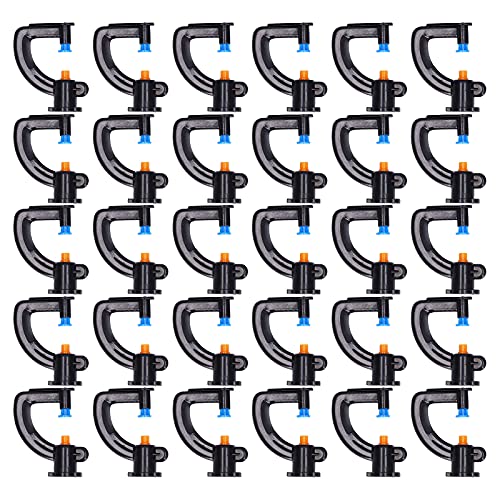
Widely Used: Spray with a diameter of 1.8 meters/5.9 feet. The sprinkler head is suitable for efficient cooling and irrigation in agriculture, gardens, terraces, greenhouses, backyards, atomization cooling, and anywhere needed.

Package Include: 25 drip emitters, 25 barbed coupling (on the emitter, take it down for using), enough to create a small irrigation system. The dripper is 5.3'' long, can be stably installed on the soil directly
Space Sprinklers Head‑to‑Head for Uniform Coverage
Measuring static pressure gives you the head‑count limit, but achieving uniform watering depends on how you space those heads. First, calculate each head’s throw diameter at the target pressure, then apply the golden rule: square spacing ≈ 50 % of throw, triangular ≈ 60 %. For spray heads, keep spacing between 4 ft and 15 ft; for rotors, stay within 25 ft‑55 ft. Place heads at rectangle corners, then along the perimeter, adding mid‑side heads only when the side length exceeds the throw. Use triangular staggered rows to reduce head count while preserving overlap, and position part‑circle heads at perimeter intersections. This layout lets you optimize sprinkler model selection and minimizes water runoff on slopes by ensuring consistent head‑to‑head coverage. Sprinkler head spacing is critical for preventing brown spots and achieving uniform coverage. Properly tightening the head ensures a leak‑free installation.
Adjust Sprinkler Head Count for Slopes and Sunlight Exposure
Because slopes and sun exposure alter both throw distance and water demand, you must adjust head count and placement to keep coverage uniform while preventing runoff. On a 2:1 slope, reduce spacing by 0.6 % per percent slope above 10 % and use low‑angle trajectory nozzles at the crest. Install top‑row heads slightly below the ridge, angled downward, and set mid‑slope heads at 45° to the surface. Bottom‑row heads tilt away from the slope to curb overland runoff control. Increase head density in sun‑baked zones, but limit overall count to preserve system performance and reduce breakage risk. Integrate soil moisture monitoring to fine‑tune application rates, ensuring each microclimate receives its required volume without excess. Properly adjust the front hole to match the volume needed for each microclimate. Adjusting sprinkler height also helps maintain consistent coverage across varying terrain. Mark wet spots with a hose to verify even distribution before finalizing head positions. Remember to shut off the main valve before performing any adjustments to avoid unintended water flow.

Matched flow rate set containing 12 specialty nozzles

3 Pack- Each Set Contains 8 Standard and 4 Low Angle (4) Nozzles