
You’ll want a gas blower if you have a large yard, wet piles, or need high air speed and volume, because gas units deliver 90‑100 dB power and 400‑500 CFM at 90‑110 MPH. Choose an electric model for small‑to‑medium lawns, quieter operation (60‑75 dB), lighter weight, and lower lifetime cost, especially if noise ordinances apply. Battery‑powered options give you 10‑month payback and virtually free electricity. Keep reading to identify which specific models fit your terrain and budget.
Which Leaf Blower Should You Choose? – Quick Decision Framework
Choosing the right leaf blower hinges on three practical criteria: power, ergonomics, and operating environment. If you prioritize raw power for large, wet piles, a gas model delivers superior output and longer runtime, but it adds weight, higher noise, and stricter storage requirements for fuel and maintenance tools. For small‑to‑medium yards, electric units win on convenience: they’re lighter, quieter, and need no fuel, so you can store them in a garage or shed without hazardous liquids. Compare ergonomics—electric handhelds reduce fatigue, while gas systems often need backpacks or wheels to offset mass. Weigh noise limits and cost; electric blowers stay under 75 dB and have lower upfront and ongoing expenses, making them the practical choice when convenience and compact storage matter. Consider also the lawn’s terrain and grass height when selecting a model to ensure optimal performance. Proper aeration before overseeding can enhance seed‑to‑soil contact and promote healthier root development. Regular dethatching helps prevent excessive thatch buildup that can suffocate roots and impede nutrient absorption.

420 CFM Powerful Airflow: Delivers up to 420 CFM of airflow for fast removal of dry leaves, grass clippings, dust, and light debris. Ideal for patios, driveways, garages, sidewalks, decks, and everyday residential yard cleanup

High-Speed Cordless Blower:This YOOVL leaf blower cordless features a high‑efficiency turbo motor, delivering powerful air speed of up to 135 MPH— twice the blowing power of conventional leaf blowers.The snow blower easily cuts through damp debris and stubborn dust, forcefully blasting away leaves, snow, and other debris efficiently, keeping yards, lawns, driveways clean and tidy.

【Blazing 990,000 RPM Turbine Motor】Engineered with a premium turbine motor, the handheld blower delivers wind speeds over 50m/s (110+ mph). Powerful airflow drives wet foliage, grass cuttings and loose debris. Aerodynamic blades sustain stable performance and prevent overheating.
How Fast Do Leaf Blowers Move Air? – Power & Performance Explained
When you look at a leaf blower’s performance, the key metric is how fast the air exits the nozzle, measured in MPH, because that speed determines the force needed to dislodge heavy or wet debris. Higher MPH gives a tighter, more forceful blast, while CFM tells you how much air you move per minute. A low‑MPH, high‑CFM unit clears light leaves over a wide area but struggles with compacted material; a high‑MPH, low‑CFM model creates a narrow, precise jet that can punch through wet clumps but covers less ground. The sweet spot—often 400‑500 CFM with 90‑110 MPH—balances volume and velocity, shaping leaf blower debris patterns that are both broad enough for yard work and powerful enough for stubborn spots. Maximize CFM levels when you need volume, and boost MPH for heavy‑duty tasks. Proper mowing frequency helps maintain a healthy lawn, and optimal mowing intervals can prevent stress on the grass.

Powerful 750 CFM Airflow and 250 MPH Air Speed - Powered by a high-speed 20,000 RPM brushless motor, this cordless leaf blower delivers up to 750 CFM airflow and 250 MPH air speed for fast, efficient cleanup. It helps clear wet leaves, grass clippings, dust, fresh light snow, and stubborn debris from lawns, driveways, patios, and garages.

700CFM High Power Cordless Leaf Blower: Tackle outdoor cleanup faster with this powerful cordless leaf blower featuring up to 700 CFM air volume and 200 MPH air speed. The high-performance motor delivers strong airflow to quickly move leaves, grass clippings, dirt, dust, and debris from lawns, patios, driveways, and yards

New Upgraded Brushless Motor More Than Just a Leaf Blower: Vitaler cordless leaf blower tackles leaves, light snow, dust, grass clippings, and stubborn debris on lawns, driveways, patios, and garages. An all-season tool for yard care and deep cleaning
Which Leaf Blower Keeps the Neighborhood Peaceful? – Noise Levels Compared
If you desire to maintain the locality serene, the noise magnitude is the deciding component, and electric leaf blowers undoubtedly possess the advantage. Electric models emit 60–75 dB, approximately 20–30 dB quieter than gas units that sit at 90–100 dB and can peak at 107 dB. At the ear, electrics score 2.9 versus gas’s 1.7; at 50 ft the gap widens to 4.8 versus 2.5. High‑frequency electric noise attenuates quickly, while gas’s low‑frequency rumble travels farther and penetrates walls, increasing area impact. This distinction facilitates meeting local sound ordinance compliance—Montgomery County caps 70 dB at 50 ft, a limit gas blowers exceed. Selecting electric thereby drives neighborhood nuisance reduction and safeguards community health. Battery‑powered models can achieve 88 dB, still quieter than many gas blowers. Understanding typical lawn mower decibel ranges helps contextualize these differences. Protective gear should also be worn when operating any mower to prevent injury. Keep the mower dry to avoid electrical hazards and engine damage.
What’s the True Lifetime Cost of Each Leaf Blower? – Cost & Maintenance
A typical homeowner will spend anywhere from $35 and $500 on a leaf blower, but the real cost story unfolds over years of fuel, electricity, and upkeep. When you compare purchase price comparisons, a gas model like the Husqvarna 525BX sits near $459, while a battery‑powered Stihl BGA 200 tops $2,261. Operating cost trends diverge sharply: a small gas commercial unit can exceed $1,000 annually in fuel and maintenance, whereas the electric equivalent draws about $2 in electricity for the same eight hours. High‑usage gas blowers hit $2,708 per year, quickly eclipsing their initial price. Battery blowers recover their upfront cost in roughly 10 months, then generate “free money” thereafter. Maintenance on gas tools demands oil changes, tune‑ups, and frequent repairs, while electric models need only periodic battery charging, delivering a lower lifetime expense despite higher upfront outlay. The hydraulic system in lawn mowers provides smooth cutting pressure which reduces wear on moving parts. Regular oil changes are essential because engine wear accelerates when oil degrades.

Efficient Cleaning: Upgraded cordless leaf blower eliminates the limitations and bulky feeling of traditional leaf blower with ropes. It can quickly blow away lightweight objects such as leaves and dust, making your cleaning work easier. Suitable for courtyards, parks, streets, and other places.

【Blazing 990,000 RPM Turbine Motor】Engineered with a premium turbine motor, the handheld blower delivers wind speeds over 50m/s (110+ mph). Powerful airflow drives wet foliage, grass cuttings and loose debris. Aerodynamic blades sustain stable performance and prevent overheating.
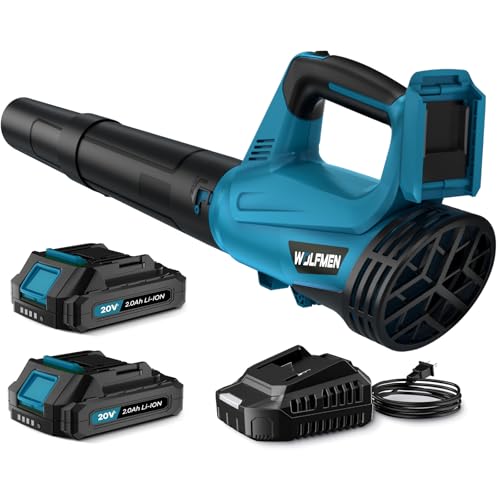
Efficient Cleaning: Upgraded cordless leaf blower eliminates the limitations and bulky feeling of traditional leaf blowers with ropes. It can quickly blow away lightweight objects such as leaves and dust, making your cleaning work easier. Suitable for courtyards, parks, streets, and other places
How Heavy Is a Leaf Blower to Handle All Day? – Weight & Handling
Backpack blowers can feel like a steady load on your shoulders, but the extra pounds add up quickly during an all‑day session. Gas models range 23.2–26.2 lb, with the Stihl BR 800 C‑E at 25.8 lb and Husqvarna 560BTS at 23.2 lb; the Powuse 65 cc weighs about 22 lb. Battery packs are lighter bare (12.9 lb for Ryobi 40V HP) but jump to 21–32 lb once batteries attach. Handheld units sit at 9–11 lb, easing short bursts but often cause wrist fatigue after an hour. Lighter backpack designs—thanks to ergonomic assistance like soft‑grip handles and anti‑vibration mounts—reduce strain, especially when you carry 2–3 lb extra over six‑plus hours. Portability benefits matter most on large properties, where balanced weight distribution lets you work longer without noticeable exhaustion. Regular mowing can also serve as a moderate‑intensity aerobic activity, improving cardiovascular health while you tend to your yard. Proper storage and regular maintenance can further prolong the mower’s useful life. Understanding battery chemistry helps you choose the right model for your usage patterns.
How Long Can a Leaf Blower Run Before Refueling or Recharging? – Runtime & Battery
Weight and handling set the stage, but the real test is how long the blower stays operational before you need to refuel or recharge. Gas models typically give you 30‑60 minutes of continuous work per tank, and you can extend that with efficient refueling strategies—swap the tank or add a larger fuel can without stopping. Four‑stroke engines stretch each fill further than two‑stroke mixes. Cordless electrics average about 94 minutes per charge, but runtime drops as battery degradation sets in, so you may see 70‑80 minutes after a few cycles. Carrying a spare pack adds another 90 minutes, while a 5‑minute quick‑charge can rescue a short pause. Corded units offer unlimited runtime, limited only by cord length and outlet access. Environmental impact is also a key factor when choosing between gas and electric models. Higher voltage batteries provide more power for longer runtimes in cordless leaf blowers. Brushless motors increase efficiency by eliminating brushes, resulting in quieter operation and longer battery life.
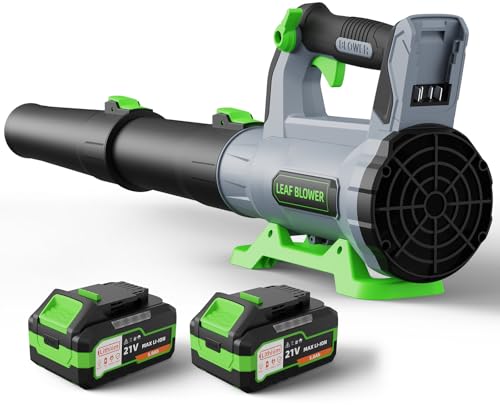
Upgrade to 2 × 5.0Ah Batteries: Our leaf blower cordless features 2 high-capacity 5000mAh lithium batteries and a fast charger, offering a working time of up to 50 minutes (25 minutes for each battery) on low speed and 36 minutes (18 minutes for each battery) on high speed. The included fast charger fully charges the battery in under 2 hours
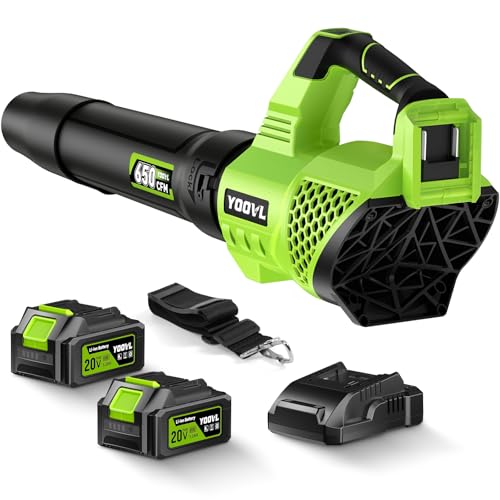
Upgraded Leaf Blower:More than just a leaf blower—YOOVL leaf blower cordless efficiently handles light snow, dust, grass clippings, and other debris from surfaces like lawns, sidewalks and garages. A must-have for year-round yard maintenance and thorough cleanups.

TURBO MODE: Battery powered leaf blower lets you power though wet leaves, caked on grass, rocks, and other debris with up to 530 CFM and air speeds up to 110 MPH.
What’s the Real Carbon Footprint of Each Leaf Blower? – Environmental Impact
Because you care about both performance and the planet, it’s essential to compare the carbon footprints of gas‑powered and electric leaf blowers side by side. A two‑stroke gas blower releases hydrocarbons equivalent to a 3,900‑mile pickup truck in just half an hour, and an hour of use matches a 100‑mile car drive in CO₂ emissions, plus CO, NOₓ, and PM2.5 that contribute to smog and health risks. In contrast, charging an electric blower emits roughly half the CO₂, with power‑plant scrubbers cutting pollutants and renewable sources further lowering impact. Lifecycle analysis shows gas extraction and E10 fuel blend add toxic exhaust, while lithium batteries, though mining‑intensive, are reusable. These differences drive environmental policy implications and spur ongoing research and innovations aimed at cleaner, more efficient blower technologies. herbicide exposure can cause skin irritation, respiratory issues, and other health problems if not properly managed. Proper disposal of old lawn mower components at a metal recycling center can prevent hazardous waste and reduce environmental impact. Diesel fuel can act as an effective weed suppressant when applied directly to unwanted vegetation.
Do Leaf Blowers Pose Health or Safety Risks? – Emissions, Fumes, and Ear Protection
When you fire up a leaf blower, the engine’s exhaust and the high‑velocity air it creates expose you to a mix of hazardous pollutants and intense noise that can jeopardize both respiratory and auditory health. Gas models spew formaldehyde, benzene, carbon monoxide, and fine particulate matter—often 30 % unburned fuel—equivalent to a 15‑hour car trip in one hour. Those particulates and dust, pollen, and pesticide residues travel up to 200 mph, lodging deep in lungs and lingering for days, demanding dust containment strategies. Noise levels exceed 90 dB, risking hearing loss without proper ear protection. Coordinated regulations now limit emissions and mandate protective gear for operators, yet electric units still produce far fewer fumes and quieter operation, offering a healthier alternative for vulnerable users. Regularly cleaning the mower’s spark plug prevents performance loss and maintains efficient combustion.
Which Yard Size Matches Each Leaf Blower Best? – Best‑Fit Yard Sizes
Most homeowners can match a leaf blower to their yard’s footprint by looking at CFM output, power source, and mobility. For a yard up to ¼ acre, prioritize yard size considerations that favor lightweight, corded electric models; a handheld unit delivering 150–400 CFM handles patios, walkways, and light debris, and 200 CFM or more clears leaves quickly with minimal upkeep. In the ¼‑½ acre range, battery‑powered handheld blowers become attractive, offering 200‑400 CFM for moderate cleanup and 400‑700 CFM for general tasks; keep spare batteries handy for runtime limits. Larger properties exceed ½ acre demand gas‑backpack or walk‑behind units—aim for 400 CFM plus, ideally 700‑1300 CFM paired with up to 160 MPH for wet leaves or sticks, ensuring sustained power and comfort. Understanding profit margins helps you price services competitively while covering equipment costs.

7 Amp motor provides a powerful and efficient blowing performance

Upgraded Leaf Blower:More than just a leaf blower—YOOVL leaf blower cordless efficiently handles light snow, dust, grass clippings, and other debris from surfaces like lawns, sidewalks and garages. A must-have for year-round yard maintenance and thorough cleanups.

UP TO 600 CFM & 150 MPH FOR FAST OUTDOOR CLEANUP: This cordless leaf blower produces up to 600 CFM airflow and 150 MPH air speed to quickly blow away dry leaves, grass trimmings, dust and light debris on driveways, patios, sidewalks, decks, garages and yards