
You can kill broadleaf weeds like creeping‑charlie and ground ivy with a diluted borax spray because boron’s selective toxicity disrupts their cells while grasses tolerate the dose. Mix 8‑10 oz of borax in 4 oz warm water, then dilute to 2.5 gal for about 1,000 sq ft, and apply during active spring growth, keeping rain off for 48 hours. Wear gloves and goggles, and store any leftover solution safely. The next sections explain soil pH, persistence, and alternative control methods.
Does Borax Actually Kill Weeds?
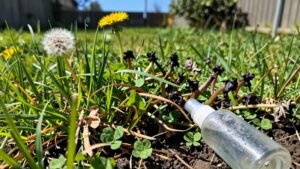
While borax can kill certain weeds, its effectiveness hinges on species, concentration, and soil conditions. You’ll find that ground ivy responds reliably, making it the primary target for a borax lawn treatment. Broad‑leaf weeds also succumb when you respect proper boron concentration factors; grasses, however, tolerate higher levels and stay largely unharmed. The selective toxicity stems from boron’s role as an essential nutrient that becomes lethal at excess, a threshold that varies by plant. Soil composition further modulates potency—sandy or low‑organic soils retain boron longer, amplifying effects, while clay‑rich soils may neutralize it. Because boron moves slowly, a single correct dose can persist for years, but over‑application creates dead zones and risks long‑term soil toxicity. Use the method only when you can match species, concentration, and soil type precisely. Mixing the solution well in the sprayer ensures even distribution across the lawn. The rapid wilting of weeds after vinegar application demonstrates how quickly a strong acid can cause visible damage. Studies on Epsom salt reveal that magnesium sulfate does not reliably act as a herbicide, underscoring the need for proven alternatives. Acetic acid in household vinegar typically reaches only the foliage, unlike stronger horticultural formulations that can penetrate to the root zone.
How to Apply Borax for Weed Control Safely
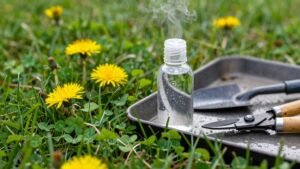
Since borax’s selectivity depends on concentration and plant species, the next step is learning how to apply it safely and effectively. Fill a plastic bucket with 2.5 gallons of warm water, then pre‑mix 8–10 oz of borax in 4 oz of warm water. Stir until the powder fully dissolves, pour the solution into a landscaping sprayer, and keep it agitated while you work. Wear gloves and safety goggles, and test the nozzle with water first to guarantee even coverage. Apply during active spring growth, avoiding rain for 48 hours. Limit treatment to lawns for creeping‑charlie control, and store the remaining mixture in a sealed, labeled container away from children and pets. This approach integrates into routine lawn maintenance while securing safe storage and minimal environmental impact. Salt can also be used as a weed control method, but it requires careful application to avoid harming desired grass. Table salt can act as a desiccant, drawing moisture out of plant tissues. Rock salt can provide a quick, localized kill for isolated weeds when applied in low concentrations.
Mix Borax Ratios for Effective Weed Control
If you want a reliable, repeatable formula, mix 8 oz of borax into 4 oz of warm water, dissolve completely, then add the concentrate to 2.5 gal of cool water; this yields a solution that safely treats 1 000 ft² of lawn without harming the surrounding turf. For larger jobs, scale the ratio proportionally: 10 oz of 20‑Mule‑Team Borax with 4 oz warm water, then dilute to 2.5 gal. When using a hand‑held pump sprayer, keep the same 8–10 oz per 2.5 gal. Perform precision mixing by stirring until the powder fully dissolves, then transfer to the sprayer. Wear gloves and safety goggles for safe handling, and keep the solution well‑mixed during application to guarantee even boron distribution. Proper soil preparation can further improve weed control effectiveness. Adding a small amount of vinegar can increase the solution’s acidity, helping to break down tougher weed tissue. Tilling the soil before applying the solution can enhance root exposure and improve herbicide uptake.
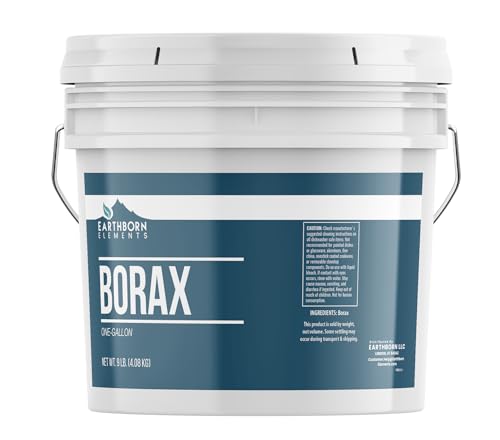
Earthborn Elements Borax Powder

USP-NF GRADE HIGHEST QUALITY: Prescribed for Life USP-NF Grade Pure Borax Powder is the highest grade quality borax available. This natural mineral salt is safe and effective for household cleaning, laundry and more. Our sodium tetraborate is non GMO, with no fillers and no additives. Borax salt has no chemical smell or toxic fumes.

Boost Laundry Power Naturally: Put a kick in your clean by adding 20 MULE TEAM Borax Powder to your detergent. It helps your laundry detergent deep-clean fabrics, tackle stubborn stains and neutralize odors, leaving clothes cleaner, fresher, and brighter
Why Borax’s Boron Toxicity Kills Broadleaf Weeds
Boron’s toxicity kills broadleaf weeds because these plants absorb the micronutrient faster than they can tolerate it, leading to cellular disruption and ultimately plant death. You’ll notice that broadleaf species have lower boron transport efficiency than grasses, so excess boron accumulates in leaf tissue, disrupting calcium balance and causing brown edge spots, wilting stems, and desiccation. In contrast, grasses tolerate higher concentrations, sparing lawns. When you apply borax, the boric acid and sodium metaborate create soil bound residues that persist, forming “hot spots” that prevent any vegetation from re‑establishing. These residues remain mobile enough to spread to adjacent areas, so you must target only the intended weed patch and avoid nearby sensitive crops. Excess boron can also accumulate in the soil, creating long‑lasting toxicity. Diesel fuel can act as a non‑selective herbicide by disrupting cell membranes in weeds, offering an alternative low‑cost method. Apple cider vinegar works by acidic foliage disruption that desiccates soft‑leaf weeds quickly.
Which Weeds Borax Kills Best
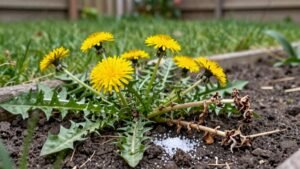
Because boron accumulates faster in broadleaf tissues than in grasses, borax works best on weeds such as creeping Charlie, ground ivy, and other dicot lawn invaders, while most grass species tolerate the same concentrations without damage. You’ll find that selective application rates—8 oz in 2.5 gal per 1 000 sq ft for lawns, or 5 tsp per quart for 25 sq ft patches—target these species efficiently. Creeping Charlie and ground ivy respond consistently when mixed with water, gloves, and goggles, delivering a boron overdose that halts growth. Broadleaf weeds beyond these, however, vary in susceptibility; excess boron can damage vegetables and ornamental plants. Monitor health impacts of excess boron, as persistent buildup may impair soil microbiota and nearby crops. Use the prescribed dilutions and avoid over‑application to protect desirable vegetation. Early detection prevents spread and helps maintain a healthy turf that outcompetes weeds. Baking soda can also be used as a low‑cost, non‑toxic alternative for spot‑treating small weed patches.
Soil pH and Type: When Borax Works
Creeping Charlie and ground ivy thrive in the low‑pH, high‑boron zones where borax is most effective, but the same solution behaves differently once soil chemistry changes. You’ll find boron most available between pH 5.0‑6.5; above 6.5, availability drops sharply, while very acidic soils (< 5.0) also limit uptake. Soil texture matters: silty clay loams hold boron longer than sand, and organic carbon (≈2 %) improves boron retention factors. Iron and aluminum oxides can bind boron, reducing mobility. Apply borax when soil tests show 2 ppm B and target a 1‑1.6 ppm increase, timing the application before weed emergence for maximum impact. Adjust pH with lime or sulfur to stay within the ideal range, and verify retention with site‑specific partitioning tests. Proper pH adjustment can also enhance nutrient uptake and improve overall lawn health. Understanding herbicide timing helps synchronize applications with weed growth stages for optimal control. Using a soil moisture probe can confirm adequate moisture levels for optimalon absorption.
Risks, Persistence, and Plant Protection
One key concern when using borax as a herbicide is its lingering toxicity: the compound can persist in soil long enough to damage both target weeds and nearby desirable plants, while also posing serious health risks to humans, pets, and wildlife. You should treat residual toxicity concerns as a core part of any environmental impact analysis. Boron remains for months, especially in dry, alkaline soils, and excess levels act like a salt, inhibiting root growth and causing leaf necrosis in broadleaf species. Humans can suffer nausea, vomiting, and kidney failure after ingesting as little as 5 g; pets are equally vulnerable, and chronic inhalation irritates respiratory passages. Wear gloves, work in a ventilated area, and keep children and animals away from treated zones. If contact occurs, rinse skin and eyes for fifteen minutes and wash clothing immediately. Some herbicides contain glyphosate which can also cause endocrine disruption in humans.
Better Ways to Fight Weeds: Hand‑Pulling, Triclopyr, and 2,4‑D
Effective weed management hinges on matching the method to the target species and site conditions. When soil stays moist and soft, hand pulling effectiveness spikes; you must extract the entire root, bulb, or rhizome to prevent regrowth. Schedule hand‑pulling sessions regularly through the growing season, especially before seed set. For woody vines, use triclopyr as a systemic herbicide; the cut‑stump technique—applying undiluted triclopyr to fresh cuts—maximizes translocation to roots and curbs resprouting. Apply triclopyr in the fall for ideal absorption, though it works year‑round. Broadleaf weeds respond best to 2,4‑D; spray twice yearly (spring and fall) at two ounces per gallon, mixing with dicamba or MCPP for broader control. Observe herbicide application timing and label instructions to protect desirable turf. Heavy rainfall can loosen soil, making hand‑pulling easier. After applying a herbicide, a waiting period of at least 24 hours is recommended before re‑entering the treated area to reduce exposure risk. Burning weeds can rapidly damage plant tissues through intense heat, offering a non‑chemical alternative for small infestations.