
You can kill many weeds with vinegar, but its power depends on the acetic‑acid concentration. A 5 % solution will desiccate very young seedlings, while 10 % works on weeds with one or two leaves and 20 % (horticultural grade) burns larger broadleaf foliage. Industrial‑strength blends (30‑45 %) are needed for mature plants, yet they only scorch foliage, leaving roots intact, so repeated applications are often required, especially for perennials. If you follow the right timing and add safe surfactants, you’ll uncover how to maximize results.
Does Vinegar Really Kill Weeds?
When you spray vinegar on a weed, the acetic acid it contains acts as a contact herbicide that rapidly breaks down the plant’s cell walls, causing fluid loss and desiccation of the foliage. You’ll see wilting within 24 hours, but only the sprayed tissue dies; roots stay intact, so timing matters. Apply on a dry, sunny morning to maximize uptake, and repeat after rain or if foliage rebounds. For young seedlings, household 5 % vinegar suffices, while mature weeds need 20‑30 % concentrations for 85‑100 % control. Use a fine mist to target foliage and avoid drift onto desirable plants. Pair the treatment with natural soil amendments—compost or biochar—to improve soil health and suppress future weed emergence without harming the ecosystem. The effectiveness can vary with weather conditions and the specific weed species. Higher acid concentrations increase phytotoxicity, but also raise the risk of soil pH alteration. Adding a surfactant such as dish soap can improve leaf coverage and absorption.
How Acetic Acid Strength Impacts Vinegar Weed Control
If you raise the acetic‑acid concentration, the herbicidal power of vinegar spikes dramatically, because each percent of acid adds roughly the same proportional increase in cell‑membrane disruption and water loss. A 5% solution only desiccates very young seedlings, while 10% reaches weeds with one or two leaves, and 20% (horticultural grade) cuts control of larger, broader‑leaf species. Industrial‑strength formulas (30‑45%) provide professional‑grade desiccation and can kill most weeds on contact, though they still spare roots. Use vinegar application techniques that guarantee full leaf coverage; a spray bottle or pump sprayer works best. Follow vinegar dilution guidelines: do not exceed recommended concentrations for safety, and adjust volume upward when using stronger acid to maximize efficacy without over‑application. Repeated applications are often necessary for perennial weeds with deep root systems. For optimal results, apply the solution during a dry, sunny day to enhance leaf uptake. Adding a modest amount of salt can further disrupt root water uptake and improve overall weed control. Bleach alternatives offer safer options for homeowners seeking effective weed removal.
Best Weed Types & Growth Stages for Vinegar Weed Control
Increasing the acetic‑acid concentration amplifies vinegar’s herbicidal effect, but the choice of weed species and its growth stage determines how many applications you’ll need. Broadleaf weeds such as plantain, chickweed, and tumble pigweed show the highest susceptibility; their wide, upward‑facing, hairless leaves retain spray longer, allowing rapid acid uptake. Target these species when they have only one or two leaves—young annuals often die after a single spray. Perennials like crabgrass or spiny amaranth need repeated treatments because deeper roots protect mature foliage. Grassy weeds recover quickly, so higher concentrations and multiple cycles are required. Timing of vinegar applications is critical: apply at germination or early leaf emergence, and prioritize understanding individual plant susceptibility to maximize control. Using a vinegar‑based spray can also help reduce soil pH temporarily, discouraging seed germination. Proper soil moisture levels can further enhance the effectiveness of vinegar treatments. Rock salt can be used as a supplemental herbicide for certain invasive species.
Step‑by‑Step Vinegar Weed‑Control Application
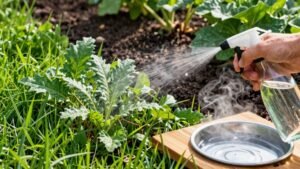
Although the best results come from a sunny, wind‑free day, you’ll start by preparing a 45 % horticultural vinegar mixture (or a 5‑6 % household version) and adding 1/4 cup Dawn dish soap and dissolved Epsom salt to improve leaf adhesion and prevent nozzle clogging. Wear goggles and gloves, then fill a pump sprayer for large patches or a spray bottle for spot treatment. Shake the solution before each use to keep the soap evenly dispersed. Aim the nozzle a 6‑inch distance, mist the weed foliage until droplets coat the surface without runoff, and work on days above 90°F with minimal breeze. Observe wilting within two hours; reapply if rain threatens. Store any excess in a sealed, labeled container away from children, and dispose of leftovers according to local hazardous‑waste guidelines to guarantee vinegar weed control safety. Epsom salt helps the solution stay effective longer. Baking soda can also be used as a low‑cost weed suppressant, providing a non‑toxic alternative for gardeners seeking safe options. Research shows that magnesium sulfate can disrupt nutrient balance in sensitive weeds, making it a potential herbicide enhancer. Using a soil pH test can help you determine the optimal vinegar concentration for your lawn type.
Limitations of Vinegar Weed Control & Add‑On Boosters (Salt, Soap, Epsom)
When you apply vinegar as a contact herbicide, you quickly reveal its biggest drawback: it only burns the foliage it touches and leaves the root system untouched. The acid concentration needed for visible burn (10‑20 %) still fails to reach roots, so repeated sprays become necessary, especially for perennials with deep taproots. Adding salt or Epsom salt can increase dehydration, but the salts alter soil chemistry, risking long‑term fertility loss and soil health damage. Soap surfactants improve leaf coverage, yet they can runoff, contaminating water and harming nearby plants. High‑strength acetic acid poses worker safety risks—skin burns, eye irritation, and inhalation hazards—so protective clothing and ventilation are mandatory. Consequently, vinegar plus boosters remain a non‑systemic, short‑term fix that demands careful handling and monitoring. For a greener approach, consider using corn gluten meal which suppresses weed germination while enriching the soil. Chlorine’s limited herbicidal effect is also non‑systemic, making it ineffective for deep‑rooted weeds.
Choosing Vinegar Weed Control vs. Synthetic Herbicides
The limitations of vinegar—its inability to reach roots and the need for frequent re‑applications—lead directly to the decision between a contact herbicide and a systemic synthetic option. When you apply 20‑30 % acetic acid, you’ll see a rapid leaf burn, often achieving a zero‑weed rating in two days, but the roots stay viable, so you must retreat roughly every 79 days. Glyphosate, by contrast, penetrates stems and roots, delivering a single systemic kill that lasts a similar interval (≈78 days) with fewer follow‑ups. Safety precautions differ: vinegar is non‑toxic to pets and children but can irritate skin, while glyphosate carries broader environmental and health concerns. A cost comparison shows horticultural vinegar costing three times more per square foot than glyphosate once labor and water usage are included. Choose based on weed type, desired frequency, and your tolerance for exposure risk. Salt can also be used, but it contaminates soil and prevents any plant growth for years. Excessive soil salinity can permanently inhibit seed germination. Properly diluting salt to a low concentration can mitigate some damage while still offering a brief weed‑suppression effect.