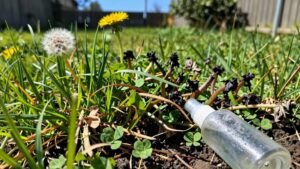

You’ll protect your lawn by timing pre‑emergent sprays when soil hits 55 °F to block seed germination, then follow with post‑emergent applications on visible foliage for systemic action. Choose selective formulas for turf so grass metabolizes the chemical while weeds absorb it faster, and reserve non‑selective options for bare spots. Mix at the label‑specified rate, add a surfactant, and spray to run‑off after dew evaporates for maximum leaf wetting. Understanding these steps will let you master weed control and keep your lawn healthy.
Timing Your Herbicide: Pre‑Emergent vs. Post‑Emergent
When should you apply herbicide for maximum efficacy? You target the weed competition timeframe by matching herbicide mode to plant phenology. Pre‑emergent products form a chemical barrier when soil temperatures hit 55 °F, exploiting soil persistence characteristics that halt seed germination before roots emerge. Apply in early spring or late summer, before rain or light irrigation activates the layer, and avoid mowing for 24–48 hours. Post‑emergent herbicides require visible foliage; they are absorbed through leaf tissue and act systemically, disrupting growth of dandelions, clover, and broadleaf weeds. Time applications for active growth periods—late spring to early summer or early fall before frost—when leaf area maximizes uptake. Combine both types for overlapping germination stages, but keep each schedule distinct to maintain efficacy. Applying a pre‑emergent in mid‑August to mid‑September is crucial for controlling Poa annua and other winter annual weeds. Adjust timing based on soil temperature trends to ensure the barrier is established before seed germination begins. Optimal weed control often requires aligning applications with the specific growth stage of the target species.

One application prevents crabgrass all season long
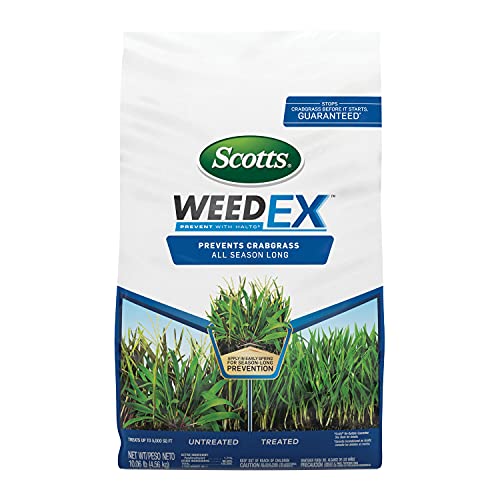
WEED PREVENTION: Scotts WeedEx Prevent with Halts is a weed control product that prevents the germination of listed lawn weeds so you can enjoy your lawn

Mesotrione, a potent herbicide, immediately absorbs and starts working upon application, yet it may take 2-3 weeks for full weed death. Activation requires water; if no rainfall occurs within 10 days, apply 0.15 inches of water.
Choosing Selective vs. Non‑Selective Herbicides
After scheduling pre‑emergent and post‑emergent treatments, you must decide whether a selective or non‑selective herbicide is appropriate for the target area. Selective products exploit physiological and morphological differences, allowing turfgrass to metabolize the chemical while target weeds absorb it faster. Because they act systemically, they minimize residual soil activity, reducing long‑term effects and environmental impacts on adjacent vegetation. Non‑selective herbicides, such as glyphosate, kill any contacted tissue via contact or systemic pathways, leaving no distinction between desired and unwanted plants. Use them only where vegetation is unwanted—driveways, sidewalks, or before new planting—to avoid unintended grass loss. Always verify label specifications, assess soil residual potential, and consider ecosystem sensitivity before application. Applying herbicides at the recommended optimal dose helps protect nearby desirable plants. Pre‑emergent products are most effective when applied before seed germination to halt weed emergence. The comparative study of Orthodontic and Roundup shows that systemic action can vary significantly between selective and non‑selective formulations.

WEED KILLER FOR LAWNS: Ortho WeedClear Lawn Weed Killer Concentrate weed killer spray kills crabgrass, dandelions, clover, and other listed common weeds in your lawn
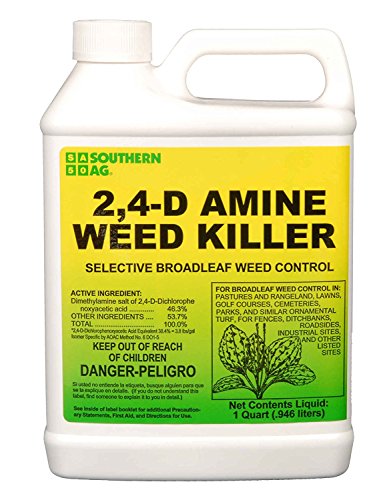
Low, economical use rate of 1 to 4 pints per acre

Controls 90+ listed weeds including white clover, dandelion, ground ivy, spurge, goosegrass* and nimblewill*
How Much Herbicide to Apply: Rates and Mixing Tips
Determining the exact herbicide rate and mixing protocol is essential for effective weed control and turf safety. You calculate rates by matching label specifications to soil texture, organic matter, and weed pressure and type. For soils with less than 3 % organic matter, apply the full label rate—e.g., 6.45 oz/acre sulfentrazone—to achieve 0.25 lb a.i./acre. Adjust upward on clay or when historic weed pressure has been high; reduce on sandy soils to avoid turf injury. Use the standard mixing formula: 2 qt/acre equals 1.28 oz product per gallon of water, scaling proportionally for your tank size. Premixed products should retain at least 75 % of the single‑active rate. Uniform mixing prevents localized hotspots that could damage the lawn. Vinegar’s acetic acid concentration determines its weed‑killing effectiveness, with higher percentages needed for mature, deep‑rooted weeds. Always wear appropriate protective gear while handling and applying herbicides to ensure personal safety. Knowing the herbicide mode of action helps select the right product for clover control.

Visible results in 24-48 hours

Now labelled for St Augustine Turf.

POWERFUL combination of Metribuzin and Sulfentrazon is labeled to treat Goosegrass, Sedges and Kyllinga, and over 50 other weeds.
Herbicide Application Techniques for Better Absorption
Accurate herbicide rates set the stage, but how you get the product onto the plant determines whether those rates translate into effective control. When you choose foliar spray, dilute the formulation to the label‑specified concentration, add a surfactant, and spray to run‑off so every leaf is wetted but not dripping. Foliar absorption factors such as leaf wetness duration, cuticle thickness, and ambient humidity dictate penetration. For root zone application, calibrate volume to deliver the solution just beyond the root tip where water and nutrients are taken up; soil pH, texture, and organic matter influence root zone application factors and herbicide availability. Apply during late morning after dew evaporates, avoid drift, and match the method to weed growth stage for ideal uptake. The speed of control can vary widely, with systemic herbicides often requiring several days to fully translocate and wilt the plant. Persistence of herbicides in soil is affected by microbial activity, which can accelerate degradation under optimal moisture and temperature conditions.
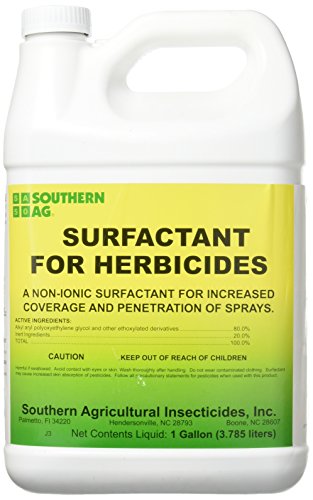
A wetting agent that increase coverage & penetration of any herbicide

Use with most pesticides to improve results
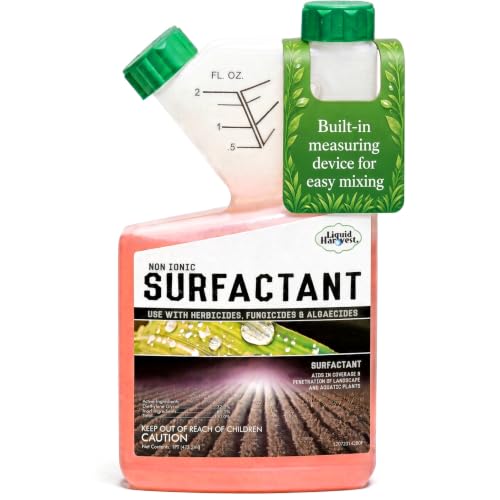
INCREASE PRODUCT EFFECTIVENESS: Surfactants help herbicides to penetrate and spread evenly across the plant surface, increasing their effectiveness.
What Each Herbicide Does to Weeds
Understanding how each herbicide class works lets you match the right product to the weed’s biology. Contact types act on foliage the instant they touch the leaf surface; they denature membranes and halt photosynthesis, delivering rapid, visible burn‑off without moving beyond the point of impact. Systemic effects, by contrast, rely on vascular transport. After absorption, the chemical migrates to roots and meristems, disrupting metabolic pathways over days, causing curling, withering, and eventual die‑off. Photosynthesis inhibitors block electron flow in Photosystem II, starving the plant of energy. Growth‑inhibiting agents target cell‑division enzymes or microtubules, arresting elongation. Root and germination blockers prevent seedling emergence or cripple root uptake, ensuring the weed cannot re‑establish. Each class offers a distinct mode of action suited to specific weed life cycles. Homeowners often overapply herbicides at low concentrations, which can delay the systemic action and lead to repeated applications. Some herbicides contain glyphosate which has been linked to health concerns when absorbed through skin or inhaled. Choosing products with low‑toxicity formulations helps protect pets and children while still managing weeds effectively. Selecting the appropriate tractor type can also affect herbicide application efficiency, especially on larger properties where ground clearance matters for maneuvering.
Spot‑Treat or Broadcast? Annuals vs. Perennials
When you decide between spot‑treating and broadcasting, the key is to match the method to the weed’s growth habit and the size of the infested area. For annuals, a localized outbreak is best handled with spot‑spraying; you can use a handheld pump or paintbrush to apply a higher per‑area rate directly to poa annua or similar species, cutting chemical use by up to 85 %. Broadcast applications work when annuals are uniformly distributed across a large lawn, allowing you to meter a lawn‑safe herbicide in gallons per acre for rapid coverage. Perennials demand precision: spot‑treating isolates persistent clumps, protecting surrounding grass, while broadcast can control widespread infestations but risks collateral damage if the formulation isn’t selective. Both strategies should fit into an integrated pest management plan and address herbicide resistance concerns by rotating modes of action and limiting total application rates. Understanding the selective systemic nature of 2‑4‑D helps ensure it targets broadleaf weeds while sparing grass. Using boiling water can also provide a rapid, chemical‑free option for small, isolated weeds. Applying herbicide to wet foliage can dilute the product and reduce its effectiveness.

LAWN FRIENDLY FORMULA: Our lawn friendly weed killer spray formula contains three proven ingredients that specifically target common lawn weeds, so it won't harm your grass (when used as directed)

KILL WEEDS NOT YOUR LAWN: Use Ortho WeedClear Weed Killer for Lawns Ready-To-Spray weed killer sprayer to kill weeds down to the root, without harming your lawn (when used as directed); you'll see visible results in hours

KILLS WEEDS, NOT THE LAWN: Won’t harm lawns when used as directed – kills more than 200 types of weeds as listed
Common Herbicide Problems and Quick Fixes
Ever wonder why a perfectly mixed herbicide still fails to kill weeds? Hard‑water mineral antagonism can bind the active ingredient before it reaches the leaf, so you’ll see poor control despite correct mixing. Use a water‑conditioner adjuvant such as ammonium sulfate; it sacrifices itself to minerals, freeing the herbicide. High surface tension also hampers leaf coverage—apply a non‑ionic surfactant to flatten droplets and improve contact. Thick cuticles block penetration; add methylated seed oil or crop oil concentrate to push the chemical through waxy layers. Drift and evaporation losses occur with undersized droplets; a drift‑reduction agent thickens the spray. Finally, schedule applications within a 6‑24‑hour rain‑free window and rotate modes of action for effective weed resistance management. Apply herbicides in early spring when soil temperatures average 55°F for several days to target germinating weed seeds. Incorporating mulch layers can further suppress weed emergence by limiting light and conserving soil moisture. Properly applied salt can act as a low‑cost weed suppressant when used sparingly on non‑grass areas.